TL;DR
- Many in the travel industry are still assuming agentic travel will look like today’s OTA workflow with a chatbot on top. It won’t. Persistent personal agents will know more about the traveler, see more context, and do more of the work consumers have always done themselves.
- This, in turn, will allow consumers to gradually place more trust in their personal agents to find quickly what would have taken them possibly dozens of hours to find on their own.
- That changes what it means for a hotel to compete. The winners won’t be the properties with the lowest rate or the highest search ranking. They’ll be the ones that can prove, to an agent acting on behalf of a specific traveler, that their property is the best fit for that trip.
- This is not how chatbot shopping works today. We are looking ahead to roughly the fourth quarter of this year when personal agents from OpenAI and Anthropic begin shopping. As with all things AI, first efforts are likely to be clumsy and error-prone, but will improve very rapidly. Don’t be put off by the inevitable poor showing of the first iteration—adoption will be rapid.
Over the past few months, I’ve spoken with a number of companies that want to occupy a position in the emerging agentic travel cycle: intent development, optional discovery research, property search, offer negotiation, purchase, offer delivery, and feedback to the agent. Most of them are assuming agentic travel will look like OTA distribution with a conversational interface pasted on top.
Ahh, nope. I don’t think so.
I wrote recently about Conway, Anthropic’s unannounced always-on agent that appeared in the Claude Code leak. Again, it was a leak, not a product announcement, but it’s far enough along that one of its discoverers, an elite-level developer, said it was likely only a few months from launch.
Conway is a persistent personal agent that appears to be under development inside an existing agent harness, Claude Code, and that kind of agent will change the way travel intent is discovered, interpreted, and acted upon. OpenAI is in the same race.
ChatGPT agent already handles multi-step tasks, including travel planning, and OpenAI hired Peter Steinberger, the creator of OpenClaw, to drive what Sam Altman described as “the next generation of personal agents.”
Why all the fuss with personal agents? For tech titans, they are the next major interface between humans and the agentic world; they are what we’ll use not only to shop for travel, but also for nearly everything else we buy. Besides commerce, they’ll also be our gateway into everything we use AI for today, and everything we’re likely to use it for in the near future. Until Neuralink is on sale at Walmart for $99, this will be how we’ll interact with much of our world.
That’s why it’s a really big deal for the frontier model companies. Travel is just a speck on the map of this technological battlefield—it is huge, and the value will accrue primarily to the few who get there first with the best products. It’s a network play: there are no trophies for the also-rans.
Coming back to travel, and to today, when the two leading AI labs are both building persistent personal agents that will sit between the consumer and every service they use, hotels need to understand what that means for them specifically. For my money, it means the hotel no longer competes primarily on price or search-page position. It competes on fit: how well its offers match a specific guest’s needs for that specific stay.
Why Fit Becomes the Competitive Arena
Think about what today’s OTA search widget actually captures—destination, dates, occupancy, and maybe bed type and a few other, generic things. That’s about it. You’re about to spend $5,000 on a family vacation, and the system knows roughly as much about your trip as a gas station attendant knows about your road trip. With that little to work with, the system compensates with volume: fire general availability requests broadly, return dozens of properties, let the user figure out what they want.
That’s the OTA scattergun model, and it rewards hotels that can win on price, sort order, or merchandising placement. And it especially rewards the OTAs that let hotels compete in their infrastructure.
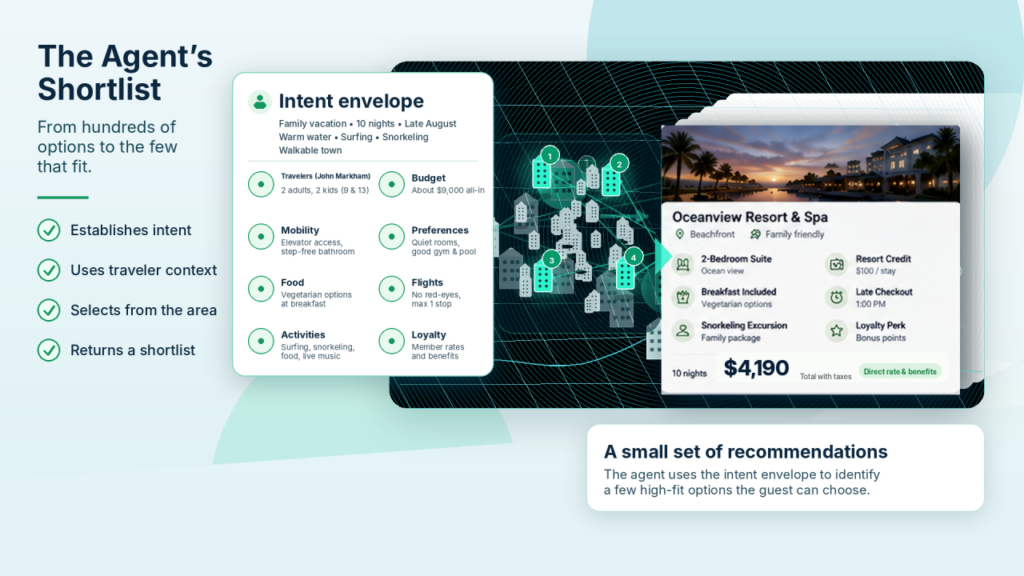
A personal agent changes the premise. Before it ever asks a hotel for live availability, it can build an intent envelope: a structured understanding of the trip that includes purpose, party composition, loyalty status, budget tolerance, accessibility needs, food preferences, etc., and disclosure rules that limit what it will tell any particular property or chain.
The agent constructs this first from the traveler’s prompt, then enriches it with its own memory of previous chats plus permissioned context (email, calendar, prior trips, loyalty programs, family composition). Sure, there will initially be privacy concerns, but users will grant more access over time as the agent proves it uses that access responsibly. That’s how delegation usually works.
A family doesn’t want “Deluxe Room, Flexible Rate.” They want a stay that works: connecting rooms, pool/beach access, vegetarian breakfast, a surf school nearby, a fitness center, a quiet side of the building, and a cancellation policy that makes sense for a trip with kids. An agent with a rich intent envelope can evaluate whether a property delivers that. A scattergun availability response can’t. It leaves it up to the guest.
Fit replaces price as the primary competitive axis. Not because price doesn’t matter (of course it does), but because an agent that already knows what the traveler needs can assess the full value of an offer in a way a sort-by-price filter never could. The hotel that can demonstrate fit to the agent has a structural advantage over the hotel that can only show rates.
From Scattergun to Rifle Shot
The mechanism behind this shift changes where hotels need to invest.
In OTA/metasearch shopping, the live availability request doubles as the discovery mechanism. The system fires broadly, often recursively, and the consumer narrows the results manually. High look-to-book ratios are the predictable outcome of this decades-old, GDS-inspired process. It’s kinda cool how the new-legacy shopping portals are still paying homage to their old-legacy ancestors.
On the other hand, a personal agent separates discovery from live shopping. It researches destinations using structured data sources and what I’ve referred to as the experience Commons: reviews, maps, local guides, social posts, Reddit threads, and all the other material travelers already spend hours reading. This layer is messy, vulnerable to fake reviews, SEO manipulation, and influencer bias.
But a good agent can triangulate across sources, weight recent signals more heavily, and reason more consistently than a human skimming reviews at 11:30 p.m. while trying to figure out whether “charming” means beautiful or falling apart.
An agent can also operate when things are unsettled in discovery. Sometimes the guest has a specific destination in mind and puts it in the prompt. Then the agent can go looking for hotels straight away. But often the guest hasn’t worked out a specific destination and wants to know what’s available. In that case, destination research and lodging research are iterative loops.
The agent might be comparing the North Portugal coast against the Canary Islands, but it can’t honestly evaluate those destinations without knowing something about what’s available to book in each one. If it finds 25 hotel options near one surf town and only three near another (all expensive), that shapes the destination recommendation. You can’t assess reviews, compare rates, or evaluate fit for properties you haven’t identified yet.
The lodging census has to come early enough to inform destination choice, not just hotel selection.
This matters for hotels because the content, structured data, and reputation signals you build for your web channel don’t become irrelevant in the agentic world. They become the raw material the agent uses during its research phase. Accurate property descriptions, honest photography, well-structured amenity and accessibility data, recent and credible reviews, and clear differentiation in your web presence all feed the agent’s ability to assess fit before it ever sends a live request.
The work you do for human/web shoppers serves double duty.
Once the destination is finalized and the agent has built a fuller picture of the lodging supply, it narrows the consideration set. The agent might start with 150 properties in a region, research 20 in detail, and request offers from each. It might get back offers the guest would consider reasonable from five or six, and present them to the traveler as recommendations. Breadth doesn’t disappear; it moves upstream into discovery and is handled by the agent, not the guest.
The live shopping phase becomes a rifle shot: narrow, intentional, and property-specific to assess fit.
Hotels have spent years optimizing for result-page position for their websites, but in agentic commerce, what matters is making it into the agent’s consideration set, and when the request is issued, making sure it lands on your official endpoint so you can respond with compelling offers that, well, fit!
Hospitality ID and the Authority-Routing Problem
You might be wondering how agents will find hotels in a particular area and how best to communicate with them about offers without going through an aggregator like an OTA. There are multiple ways to do this today, but an upcoming opportunity with tremendous promise is the Hospitality ID.
Hospitality ID could become a significant piece of this infrastructure. PhocusWire reported that the project, founded by Robert Cole, is expected to launch in beta in Q3 2026. Robert described the Unique Hospitality Identifier as a persistent ID that survives ownership, brand, and technology changes, with a deliberately minimal core record (just six fields: ID, name, address, phone, geo-coordinates, and number of units).
It’s a registry, not a data store, and that’s just what we need for agentic hotel commerce.
The part that matters most is what Robert calls “pointers.” The registry assigns the property its persistent address and the pointers tell agents where the servers are, whether that’s an MCP server (one that’s designed specifically to talk to agents), a booking engine, a content store, a real-time availability feed, or any other system the hotel authorizes. The registry doesn’t care what’s behind the door.
Those decisions belong to whoever controls the property record, and pointer access is permissioned: public, contracted partners only, or restricted.
A hotel that participates controls its own authority routing. A hotel that doesn’t still gets an ID (the ecosystem will assign one), but an intermediary or aggregator can jump in to define where the pointers go. If that sounds familiar, it should. It’s the same dynamic that played out 20 years ago when hotels that didn’t build their own web presence let OTAs define the guest relationship on their behalf.
As I’ve said before, let’s learn the lesson about intermediaries; tuition was high enough the first time.
And as I noted above, the registry doesn’t just matter at the shopping phase. When the agent asks “what lodging exists near this surf town?” during destination research, a comprehensive registry with geographic identifiers gives it a real answer instead of a patchwork of map listings and OTA inventory.
Offer Construction Is the Real Opportunity
When the rifle shot lands on its authorized endpoint, the hotel’s opportunity changes in a big way.
OTAs can personalize shopping using clickstream and booking history. But the deepest personalization requires the hotel to know who the guest is, match them to a hotel-controlled profile, and operationalize their preferences at the property level. OTAs don’t want to disclose the shopper’s identity to the supplier because it weakens their control of the customer relationship. (They’ve been pretty open about this, actually. It’s not a conspiracy, it’s a business model.)
The agentic direct channel creates a different possibility.
The hotel’s system can receive the relevant details about the trip including, for example, a loyalty program ID, and construct a more personallized offer: not “Deluxe Room, Flexible Rate” (the glorious sum total of what decades of distribution innovation has given us), but connecting rooms on the quiet side of the building, pool access confirmed, vegetarian breakfast, a partner surf school, late checkout, and a clear cancellation policy that fits the guest’s needs.
Then bring in entitlements from the guest’s loyalty status, like late check out and extra room amenities, and all the preference items you’ve gathered, like feather pillows, extra towels, and a 68-degree setting for the climate control—things only available on a direct booking. An offer built to fit the trip, a bundle with no comparable room type / rate plan combination like you’d find on an intermediary.
And by the way, the buyer agent’s search need not be restricted to what is gathered in the intent envelope. The existence of the partner surf school above might have been part of the property description rather than in the ARI feed an intermediary gets. The buyer’s agent can see it and relate it to a memory of a surf school booking in a previous trip, making it part of the recommendation even if the traveler didn’t request it in the initial prompt. Try that with an OTA!
You might be wondering how hotels can participate meaningfully in agentic channels. Large hotel companies can build these direct (MCP/agent) connections themselves. Many hotels can’t…yet. But new infrastructure companies are appearing to help smaller brands and properties participate more quickly.
Nuitée, DirectBooker, SiteMinder, and others are building tools that let hotels expose real-time rates, availability, and direct booking capabilities to AI platforms. Whether these intermediaries can eventually deliver enough depth (identity, loyalty, offer management, fulfillment) is the unresolved question. The first wave will probably look like direct rates exposed to AI platforms. The next wave should look like real offer construction.
That’s where things get interesting and demand begins to shift significantly between channels.
Three Things Hotels Should Be Doing Now
When a personal agent decides which properties deserve live offer requests, how do you make sure your property is one of them?
First, be researchable. The content, structured data, and reputation signals you maintain for your web channel are the same raw material the agent will use during its discovery phase. Accurate property descriptions, structured amenity and accessibility data, good (and honest) photography, recent reviews, and clear differentiation all help the agent assess fit. You should already be doing this work for your web channel. Using it for the agentic channel just means it starts paying off twice.
You can use this “2-for-1” concept to brighten your CFO’s day.
Second, be findable, identifiable, and agent-ready. The agent needs to know your property exists, figure out that five different listings across maps, OTAs, brand directories, and social posts are all the same hotel, and find your official endpoint. Hospitality ID is designed for exactly this, but until it reaches critical mass, hotels should ensure their identity is consistent everywhere an agent might encounter them.
Consistent name, address, and phone data across platforms; accurate map and directory listings; and clear, structured information on your own website all reduce the chance that the agent misidentifies you or routes the request somewhere you don’t control.
But being findable isn’t the same as being agent-ready, and having a website isn’t enough. An agent can’t negotiate with a web page. You need an MCP server (essentially a structured connection point that AI agents can query directly) that you can anoint as the final authority for your property. You can build one, or you can rent one through an infrastructure provider. Sign up for Hospitality ID as soon as possible so your pointers lead agents to your endpoint rather than to an intermediary.
Ideally, you’d also have a seller agent in front of that endpoint, one that can interpret the guest agent’s intent, fashion personalized offers, and negotiate back and forth to optimize fit. That’s a more advanced capability, but it’s where the channel is heading, and hotels that get there first will have a meaningful edge.
Third, be ready to construct a rich, personalized offer. Having an endpoint is table stakes; what you put behind it is where the competitive separation happens. A hotel that can return a stay-specific offer built around the individual traveler’s needs gives the agent something better to recommend than a generic room and rate. That means connecting your endpoint to your PMS, CRM, loyalty program, and operational systems so the offer reflects what you can actually deliver. Start with what you have.
Even basic rate and availability through an authorized connection is better than letting an OTA be your voice in the conversation. Then build toward richer offer construction as the tools mature.
The OTA era began because consumers wanted to see the larger market, rather than just the small slice a human agent showed them. The agentic era begins because consumers want someone else to do the work. Hotels that prepare for both the research phase and the offer phase of agentic shopping will compete on fit, not just price. And fit, once the agents are good enough to evaluate it, is a game that favors the supplier who actually knows the guest.