At Stripe Sessions earlier this year, Patrick Collison said Stripe (a highly successful payments company) had “kind of arbitrarily decided” that the singularity began on January 1st. If you’re wondering what the singularity is, the singularity is the point where advances in AI begin accelerating so quickly—and amplifying one another so strongly—that technological and economic change starts moving faster than our normal ability to predict or plan for it.
Don’t worry, it’s not some woo-woo sci-fi thing: Hal will still open the pod bay doors for you, but old assumptions about rates of change just don’t hold any more. Sam Altman didn’t exactly disagree: “It does feel like we are somehow in the takeoff.” Collison’s larger point was that Stripe was seeing a number of its own metrics suddenly turn parabolic. Startup formation is on an absolute tear.
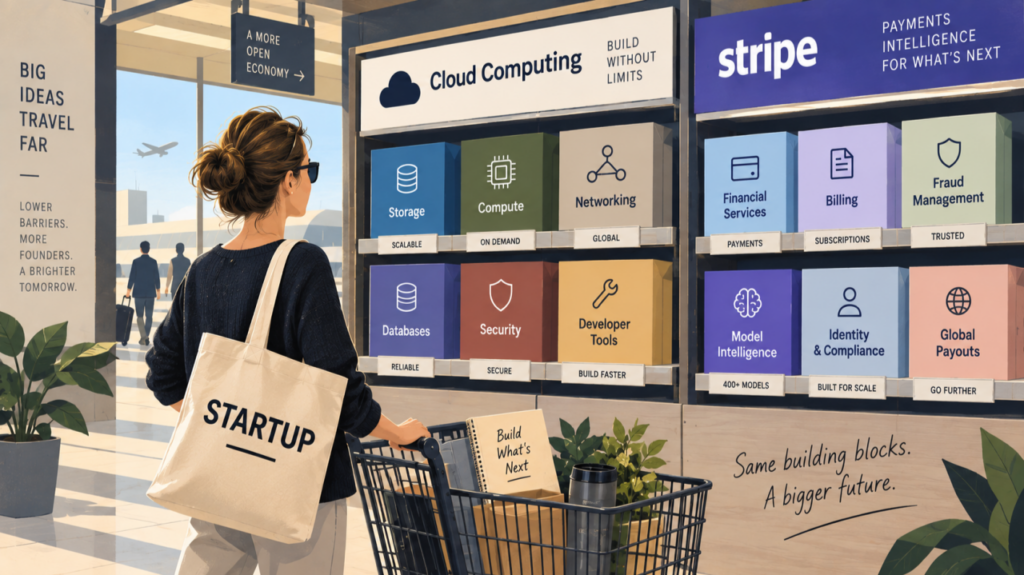
So last month, Stripe put its money where its mouth is when it agreed to acquire OpenRouter, which provides a single gateway to more than 400 AI models from 80+ providers. Think of it like a channel manager for LLMs. Stripe already provides a lot of the financial infrastructure startups need; OpenRouter does the same for intelligence. A new startup can now rent payments, billing, fraud management, compute, storage, models, and specialized intelligence rather than building those capabilities itself.
AWS helped create the first generation of startups by letting them rent computing infrastructure. Stripe is helping make intelligence and business services rentable in the same way. Stripe
The startup barriers are coming down together
That’s why I think we’re entering a second age of startups. This isn’t just about AI helping programmers code faster, though it can certainly do that. Multiple longstanding barriers to building companies are falling at once.
As I wrote in Will the SaaSpocalypse Come for Travel Tech?, agentic engineering is dramatically reducing the time and cost required to create software, which will cause some incumbents to shed knowledgeable staff. And as I argued earlier in AI Is Not a Tool—It’s the Work, AI is beginning to perform work that previously required employees across multiple functions.
Add cheap infrastructure, and we’re doing more than reducing startup costs—we’re expanding the pool of people who can realistically create one.
Sam Altman even described this at Sessions as the “revenge of the idea guys.” For years, investors were skeptical of nontechnical founders who arrived with a great idea but needed somebody else to build it. Altman now says people who deeply understand their customers but can’t code have suddenly become much more fundable.
I’ve been working with a number of startups over the past few years, and they feel very different from startups I worked with just five years ago. They’re moving incredibly quickly, testing continuously, and are ready to change direction on a dime. The real advantage isn’t just that they’re cheaper to get going. It’s that they can run a lot more learning cycles than a legacy company in the same amount of time. And they don’t feel compelled to test everything until they’re convinced it’s 100% perfect.
They ship when things are safe, and work on perfection over time.
Startups don’t have to inherit our org chart either
I wrote about another part of this in Block’s Bet: What the World Model Means for Hotels. Block is experimenting with an organizational model where AI handles some of the context gathering and information routing that organizational hierarchies historically performed. An incumbent can use AI to remove pieces of an existing hierarchy.
A startup has an even bigger advantage: it doesn’t have to build much of that hierarchy, or all of the communication, approvals, decision paths, and all the other reasons for those 30-person Zoom calls in the first place.
This gets particularly interesting for travel technology vendors
Still think your competitors are the ones you’ve been slugging it out with for the past decade? A startup no longer has to build another gigantic PMS, CRM, or CRS to challenge an incumbent. As agentic operating platforms emerge, it may be possible to build one exceptionally good capability that occupies a valuable slot usually buried inside a monolithic application.
But these capabilities need somewhere to live. They need shared context, identity, permissions, data and tools, orchestration, security and monitoring. They’ll need some kind of platform, or operating system, to run on. Some platforms will come from frontier model companies, and believe me, all the big guys are in it to win it.
For example, OpenAI’s Frontier is explicitly designed around shared enterprise context and can accommodate agents developed internally, supplied by OpenAI, or integrated from other vendors. Anthropic offers something similar through its Agent SDK, Managed Agents and MCP ecosystem. Others will come from companies that want to commoditize the LLMs, like Microsoft Foundry, Palantir AIP, and similar platforms.
Still others will come from new companies that are building more vertical, travel-aware platforms designed specifically to run in hotels. These are highly specialized platforms that can connect to a company-wide platform like Frontier, but embed deep industry knowledge and more extensive feature sets. Expect to see these become more visible over the next 6 months. I know of at least two in the works.
By the way, the above are very different from much of what hotel tech vendors currently call a “platform.” A genuine agentic platform won’t only contain applications written by its owner. It provides rails (like APIs or MCP connections) for agents, skills, and tools from many companies to run on and cooperate.
That means incumbents could increasingly be attacked one valuable capability at a time. If you work at a tech vendor, it’s time to bust out your copy of “The Innovator’s Dilemma’ so you can read the script on what’s coming.
Don’t just AI-enable yesterday’s company
There are plenty of good incumbent responses to battle disruption: eliminate coordination-induced customer friction, identify prices supporting legacy cost structures rather than customer value, turn proprietary knowledge into agent-usable context, make distribution an accelerator for new products, and decompose your own products before somebody else does.
But I’ll add one more. Companies are spending enormous amounts of time asking how to infuse their existing workflows and processes with AI. That’s probably a necessary stage to get through, but it’s not going to shore up your prospects for long. Your startup competitor has no existing workflows or processes to protect.
They’re going to ask what combination of humans, agents, and systems produces the greatest customer value, with the highest certainty, at the lowest cost—and build that process from scratch.
Incumbents should ask the same question. Existing processes are essentially sunk costs. Let that sink in (pun intended). Sometimes they’ll provide a useful foundation, but often they’ll just automate yesterday’s assumptions.
Why This Matters Beyond Startups
There may also be another, bigger benefit to the second age of startups. Bill Gates just published a 12-page manifestoon the disruption AI is likely to bring to work and society. His basic message is pretty bleak: “There is no plan to ease the entry into the AI era.” He expects significant job displacement and says that we need to start figuring out how people will make the transition to new jobs and roles.
One piece of that answer may be a nice byproduct of the Second Age: some of the people leaving big companies will take their domain knowledge with them and start companies of their own. Those new companies probably won’t employ nearly as many people as the companies they’re disrupting, so this isn’t a magic solution to the employment problem, but there may be a lot of them.
And making it much easier for people to create new businesses is a pretty useful capability to have during a period when we’re eliminating old jobs.
The first startup revolution democratized access to computing. This one is democratizing access to intelligence. And that means we aren’t just making existing startups more powerful; w e’re also making it much easier for new ones to be born.
And just in time!