I recently heard a travel industry expert remark, “It’ll take time for GenAI to come into companies, regulated by the pace at which they’re prepared to adopt it.”
I sure hope not!
This is no time for the travel industry to sit back and wait for items to clear off a 100-item backlog before we can comfortably think about our GenAI strategy. It really is time to build—now, and thoughtfully.
While many people naturally resist change, doing so in an era of rapid transformation like this is a risky move. While companies are touting their GenAI visions across the board, when I peek under the covers, I see that even the biggest names in travel are all talk. They’re delivering little that uniquely comes from GenAI rather than from standard machine learning and data analysis.
There seem to be two common ways companies in travel are dragging their feet. First, some are taking only tentative steps—ticking off marketing checklist items or implementing GenAI in ways that reinforce their current business models. These brands, some of whom were digital leaders during the Internet revolution, aren’t stepping up for the GenAI revolution. As a recent BCG article titled Are Digital Natives Losing Sight of the Digital Basics? points out, even once-dominant digital natives are now showing legacy behaviors, while new challenges arise from fresh, nimble competitors.
“They may be only in their early twenties, but the older digital natives are feeling their age. The 2022 tech selloff has taken the air out of premium valuations, and behind the market retreat, many former high-fliers now appear vulnerable to business disruption themselves. Just two decades ago, the dominant business paradigm saw digital natives driving sluggish incumbent companies into extinction, with striking examples in media, retail, and travel. Now a resurgent class of digital incumbents are fighting back, and aging digital natives are exhibiting legacy behaviors themselves.”
The second approach is to fully “wait on the sidelines to see how things shake out.” It’s become almost prudent to point out that previous technology revolutions allowed smart companies to wait before leaping in. But this reasoning falls apart when you consider that past general-purpose technology revolutions:
- Never progressed at the breakneck speed of GenAI, and
- Never involved the creation of intelligence itself.
The industrial revolution took 80 years to mature, the electrical revolution about 40 years, and the digital/internet revolution around 20 years. We can’t even imagine where the GenAI revolution will be in 10 years. Many AI experts even speculate that we might reach artificial general intelligence (AGI) by 2025 or 2026, at which point we could see an even more dramatic acceleration. If getting started seems hard now, catching up later will be far tougher.
GenAI Opportunities Are Everywhere
The message isn’t just doom and gloom for those reluctant to change—there’s a tremendous upside to acting now. For instance, in Passion Travel Is the Future by Thrillist, a survey of 2,000 Gen Z individuals revealed that:
- 72% say traveling is core to their identity and how they express themselves.
- 87% of Gen Zers and 89% of millennials say travel is a financial priority—more so than any other generation.
- 84% prefer destinations that are off the beaten path.
- 77% choose travel experiences based on passion points rather than the destination itself.
The takeaway? Travel is set to become even more important, and these cohorts are searching for experiences that a standard from/to/when search widget simply cannot provide. Just as websites had to dramatically upgrade their interfaces when iPhone and Android apps redefined user expectations 10-15 years ago, travel sites must evolve as users become accustomed to intelligent interactions with GenAI. In other words, as users experience enhanced search from GenAI chatbots in other parts of their lives, the gap between their travel planning expectations and what’s available online will only widen.
Personalization: The Next Frontier
GenAI’s first-mover advantage will be even more pronounced than what we saw with early web UIs. Both deliver a better user experience, which drives usage, but GenAI brings a powerful element of personalization that drives loyalty. Once a traveler’s personalization data is enmeshed in a travel planning tool, they’re far more likely to return for the most user-centric and up-to-date recommendations.
Consider this: Millennials are now the largest living cohort in the US at around 72 million, with Gen Z close behind at roughly 68 million. These travelers aren’t satisfied with the generic tours that pop up on an OTA or a simple query response from an LLM. They want highly personalized recommendations. And while GenAI travel planning has yet to fully meet this demand, the potential is enormous.
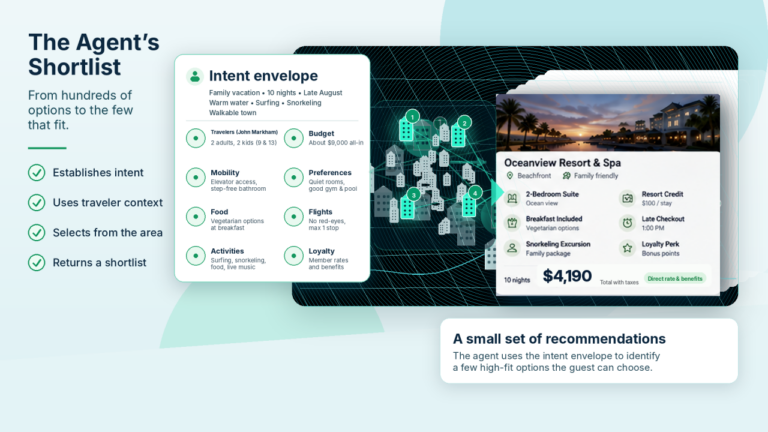
When we talk about personalization here, we’re referring to matching a traveler’s specific wants and needs—not just the most profitable options for search engines or suppliers paying to play. GenAI can offer true personalization throughout the travel planning process and even in enhancing guest experiences. L.E.K. Consulting observed that by analyzing guest preferences, past stays, and social media cues, GenAI can generate individualized recommendations and content on the fly. Imagine a hotel model that drafts a custom welcome message, highlighting vegan dining options and nearby yoga studios for a wellness-focused traveler, or curates a day-by-day itinerary based on unique interests like cooking, surfing, or hiking—all delivered through a hotel app or chatbot concierge.
This isn’t the old-school AI personalization based on regression or ML tools that merely optimize outbound emails. Those methods have generated revenue, but they miss the mark on delivering genuine, customer-centric personalization while attending a trip.
Revolutionizing Travel Planning
For travel advisors, tour operators, and planners, generative AI is a double-edged sword—a threat if ignored, but a game-changing ally if embraced. On one hand, travelers now have direct access to AI tools that can generate entire itineraries in seconds, potentially bypassing traditional agents. On the other, these same tools can supercharge an agency’s productivity and creativity.
As noted by Skift, travel agents and tour operators have a huge opportunity with GenAI. Agencies can use AI as an assistant—logging customer interests and constraints to rapidly draft itineraries, which are then refined with human expertise and local insights. This hybrid approach means agencies can iterate options faster and serve more clients with the same staff. Similarly, tour operators can leverage AI to create new tour concepts or tailor trips—imagine outlining a day-by-day culinary tour in Japan (sushi-making class, local market visit, sake brewery stop, etc.) in a fraction of the time, then validating and booking the details. The result is highly tailored trips delivered at scale, preserving the unique value of human experts in the loop.
Online travel agencies and metasearch platforms, once disruptors of the past, now risk being upended by the AI wave. Consumer behavior is shifting—more leisure travelers are cobbling together GenAI tools for travel inspiration, planning, or booking. A recent survey from Oliver Wyman found that more than a third of leisure travelers had recently used generative AI for travel, and about half of those went on to book based on the recommendations received. As consumers become more accustomed to interacting with GenAI chatbots (replacing many questions previously sent to Google), engagement with AI for travel discovery will surge. While incumbents currently lean on traditional travel search to protect their margins, new entrants with GenAI-centric search and significantly lower costs to serve will capture traveler interest. Google, for instance, showcased a next-generation GenAI-powered travel planner with a fully dynamic itinerary at Google I/O in June 2024. It hasn’t seen the light of day yet, but it’s on the horizon.
Automation & Cost Reduction
Beyond enhancing the traveler experience, GenAI can streamline operations and cut costs. Routine tasks across travel—from customer inquiries to modifications and after-sales support—can be automated using chatbots and AI agents. For example, buy-now-pay-later company Klarna implemented a customer service chatbot that answered 70% of inquiries within the first month of deployment, all while maintaining or even improving their NPS ratings. This resulted in an annualized cost reduction of roughly $40 million, and as the model learns more, that answer percentage is likely to increase.
For those who hesitate, the risks are clear: a lukewarm embrace or sitting on the sidelines could leave companies far behind as GenAI reshapes the industry.
New Entrants and the Shifting Competitive Landscape
The sweeping adoption of GenAI will give rise to new, hyper-efficient, AI-native companies that integrate GenAI in three transformative ways:
- At the Individual Level: Staff at these companies will harness large language models (LLMs) for nearly every task—from creation and design to critique. Imagine engineers using AI copilots to write and debug code at speeds far surpassing unaided efforts. Recently, Sam Altman casually mentioned that OpenAI’s internal (not yet released) coding companions perform at the level of the 50th best coder in the world. Just think what that could do for product development!
- Horizontally Across Business Functions: Companies will build around a common core of AI resources, integrating systems that share data and capabilities to enhance both operational efficiency and product quality. Customer service feeds product, product feeds engineering, sales feeds legal, and on and on.
- Vertically in Business Strategy: By addressing customer needs more effectively with new products, services, and business models, companies will create more compelling unique value propositions.
But what about the incumbents? The consensus is that the traditional travel world isn’t moving fast enough to keep pace with GenAI’s potential. Three sources, however, could ignite a fire under incumbents:
- GenAI-Native New Entrants: Companies without legacy infrastructure or outdated mindsets to overcome. Remember the internet revolution of the 1990s? Incumbent travel agencies, GDS, and suppliers took a wait-and-see approach, only to be disrupted by agile, internet-native OTAs and Metasearch companies. History is poised to repeat itself, and GenAI is poised to be even more significant.
- Incumbents Outside of Travel: Frontier model developers like Google and OpenAI are already pushing boundaries. Recall Google demonstrated a dynamic itinerary generator last year, and Perplexity has launched a specialized interface for shopping across the web. With the cost of reasoning models plummeting (thanks to new releases from Google, DeepSeek, and Kimi), it’s becoming easier and cheaper for startups to develop surprisingly capable travel planning and search capabilities.
- Device Manufacturers: Companies like Apple and Google stand to benefit significantly. With initiatives like Apple Intelligence and Google’s Gemini Assistant, these on-device agents could become the primary interface for everything consumers do—from planning a trip to making purchases. It doesn’t take a genius to see a world where every thought about travel or shopping or whatever starts with “Hey Siri…”—our devices, armed with an abundance of personalization data (emails, texts, files, spending history, etc.), could build the most comprehensive user profiles ever, offering tailored recommendations that truly resonate with individual needs.
The world of travel used to belong solely to travel companies. That distinction is rapidly blurring. In the past, incumbents felt insulated because giants like Google were more focused on preserving advertising revenue. But with AI answer engines upending traditional ad models, Google now has far less to lose—and much to gain—by directly engaging with huge industries like travel.
Will GenAI Really Deliver on Its Promise?
GenAI has been on a tear for over two years now, accelerating day by day. While frontier model developers like OpenAI, Google, and Anthropic have invested billions in model development—driving the price of intelligence/inference down by orders of magnitude—the pace is only expected to quicken. And there’s more good news: the GenAI industry recently received a significant boost from some giant-sized initiatives.
Take the Stargate Project, announced on January 21 as a $500 billion investment in AI infrastructure. Funded by SoftBank, OpenAI, Oracle, and MGX, the project aims to create both physical and virtual infrastructure for next-generation AI advancements.
At the AI Action Summit in Paris, European Commission President Ursula von der Leyen announced InvestAI, a major initiative to mobilize €200 billion in AI investment—€50 billion from the Commission and €150 billion from private investors.
At the same summit, Vice President JD Vance outlined the Trump administration’s pro-growth, deregulatory approach to AI, emphasizing:
- Against Over-Regulation: Excessive AI regulation could stifle innovation, especially in Europe.
- U.S. AI Leadership: The need for US domestic advancements, particularly in AI chip manufacturing.
- Global AI Competition: The importance of developing AI within democratic values while avoiding partnerships with authoritarian regimes.
With all the time, money, and effort that’s been poured into GenAI—and with these massive initiatives and policy shifts—it’s hard to imagine we won’t soon see revolutionary changes in both GenAI capabilities and the travel industry. The opportunities are endless, and the risks are existential. As the saying goes, the best time to have started experimenting with GenAI was in late 2022; the second best time is today.
Key Takeaways:
- Act Now: Waiting is not an option—if you think it’s hard to start, imagine how hard it will be to catch up later.
- Personalization Matters: True, customer-centric personalization will be the key differentiator in travel because Millennials and Gen Zers will insist on it.
- Hybrid Models Can Win: Combining GenAI with human expertise can redefine travel planning.
- New Competitors Loom: From agile, GenAI-native startups to tech giants like Apple and Google, the competitive landscape is set to change dramatically.
- Massive Investments Are Underway: Global initiatives and huge investments in AI infrastructure signal that the GenAI revolution is just getting started.