I’ve been writing for a while about the rise of personal agents and my belief that they will eventually become the new aggregators, doing our research, remembering what we like, and increasingly helping us decide where to spend our money. When I wrote Personal Agents: The New Aggregators Come to Fruition, much of that was still about connecting the dots between emerging capabilities and imagining where they were headed.
Over the past few months, and especially with recent announcements from Apple, Meta, and Google, a lot of those dots have turned into actual products. So I thought it was time to take another look.
Last week I watched Apple introduce another round of devices and, once again, talk about Siri AI as though it had suddenly become the smartest kid in the class. I have to admit this makes me a little twitchy. I’ve been an Apple fanboy ever since they introduced the iPhone, but two years ago they introduced the “new Siri” with equally impressive demos, only for customers to discover that Siri was completely incapable of doing many of the things Apple had shown.
I felt betrayed and, judging from the reaction at the time, plenty of other people did too. So when I had the chance to join the developer beta for iOS 27 and the new Siri in June, I jumped in quickly to see whether Apple had actually built what it was advertising.
The answer is: sort of. Siri AI is clearly better than what we had before, but nobody in the executive suites at OpenAI or Anthropic is watching it and reconsidering their career choices. Compared with ChatGPT or Claude, it still feels constrained in ways that become obvious pretty quickly if you’re accustomed to working with frontier models. For the first few days, that reinforced my belief that Apple had once again managed to bring a knife to an AI gunfight, and a really small knife at that.
Then I started to wonder whether I was looking at the wrong fight.
Maybe Apple doesn’t need the smartest agent
Let me get one thing out of the way first. Even if the ghost of Steve Jobs himself materialized in my office and swore on his legacy that this was Apple’s carefully considered AI strategy two or three years ago, I wouldn’t believe him. No amount of reality distortion field could have convinced me. Apple’s AI program was a mess.
Senior leadership changed, deadlines slipped, promised capabilities failed to appear, and one of the best-run companies in the world suddenly looked like everyone had assumed someone else was handling AI. Whatever strategy they have today was almost certainly not the strategy they thought they had when this started.
But somewhere in the process of digging themselves out, whether on purpose or not, Apple may have stumbled, and I do mean stumbled, onto something much better: Siri doesn’t need to be the smartest personal agent in the world. It needs to be the easiest personal agent in the world. The one your aunt Edna, bless her 85-year-old heart, could try out and come to love.
That distinction matters because Apple and OpenAI are playing very different games. OpenAI and Anthropic need to build models and agents so good that people actively choose to use them, and one primary tactic is including memory systems that make their models feel very personal as well as capable. That makes them sticky. On the flip side, Apple makes its money selling devices.
Tim Cook has been making essentially the same point for years: that Apple’s customer is the person buying the product, not an advertiser trying to reach that person. As Tim put it, with Apple, their devices are the product, not the users of the devices. This is in contrast with companies like Meta and Google who monetize the user through their advertising.
So if Siri makes an iPhone, Mac, Watch, or pair of AirPods more useful and makes customers a little more reluctant to leave the Apple ecosystem, Siri is doing its job.
Apple also begins with internal advantages the frontier labs are only now building from the outside. Siri is sitting directly on the devices, surrounded by messages, email, photos, calendars, contacts, applications, location information, and the semantic index Apple has been developing to understand how all those things relate to one another. A model that is meaningfully behind the frontier can still do some pretty impressive things when it starts with that kind of context.
Siri probably isn’t going to solve a Millennium Prize problem anytime soon, but as it happens, I don’t generally do that kind of thing on my phone anyway. What Apple really needs is something convenient enough that you use it without thinking: push a button, say what you want, and have something useful happen. Occasionally it should do something impressive enough that you tell somebody else about it.
That is a much lower hurdle than building the world’s best AI model, and Apple may be unusually well positioned to clear it. Remember the Apple mantra “It just works”? It applies here more than ever.
The more interesting part is what happens next
This is where I think Siri gets much more consequential. Apple already has hundreds of millions of devices capable of running its new AI functionality, and that number will keep growing rapidly as people replace older hardware. The new Siri will ship with iOS 27, so you don’t have to install anything if you have a compatible device; just update to the new OS. Google and Meta have similar advantages.
Google will start pushing Spark to their enormous Android and Google ecosystem, while Meta can push Muse through applications like WhatsApp that are already used by gigantic populations around the world.
None of that means billions of people suddenly wake up next Tuesday with fully functioning personal agents. Think of the installed base as a stock and adoption as the flow coming out of it. The flow will be only some fraction of the stock, but when the stock is measured in billions, even a fairly small flow becomes a very large number of people learning a completely new behavior: asking an AI to do things for them.
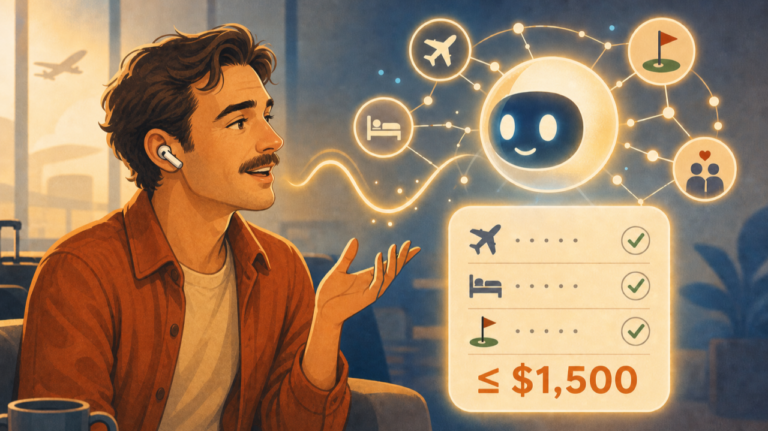
Once consumers become accustomed to saying, “Find this for me,” “Compare these,” “Remember that,” “Make the reservation,” or “Figure out what I should buy,” the personal-agent category has been activated. People begin to understand what an agent can do and, maybe more importantly, what it can’t do.
That’s where OpenAI and Anthropic come in. I think a lot of people will be perfectly happy with Siri, Spark, or Muse, but some percentage will hit a ceiling or have a trust issue. A friend will show them something ChatGPT did. They’ll read an article about Claude. Somebody at work will demonstrate a much more capable agent. Apple doesn’t need to send them to ChatGPT; the rest of the world will take care of that.
Once they try one of the frontier agents, some will discover a huge difference between asking Siri to hand off a question to another model and working directly with an agent that knows their history, preferences, projects, and prior conversations. Remember that bit about how the agents use chat memory to make their models feel more personal and just…better? This is where it comes into play.
That doesn’t necessarily mean abandoning Siri. I can easily imagine using Siri for everyday “walking around town” tasks while using ChatGPT or Claude for more complicated work. Apple may even invisibly route difficult requests to frontier models over time. But the important thing is that Siri may have taught me the behavior in the first place. Apple gets to keep selling me devices, and OpenAI or Anthropic gets a customer who already understands why a personal agent is useful.
That’s a pretty good arrangement for everybody. In consultant-speak, they’re complements in this scenario: using one actually increases the likelihood of using the other, even though they’re still competing for some of the same work on the low end.
Meta and Google have their own complications
Meta can activate an enormous number of users through Muse, but it comes into the personal-agent market carrying a piece of baggage Apple doesn’t have: trust. I saw this firsthand a while back with my Ray-Ban Meta glasses. When I bought them, I could choose not to allow certain AI voice interactions to be stored, and given what I knew about Meta, I quickly checked that box. Within days (and I don’t think they were just waiting for me to buy the glasses) Meta changed the terms and removed that option.
I remember thinking that I had bought the product under one privacy arrangement and Meta had unilaterally decided, after the fact, that I would be getting another one, so I returned the glasses.
Muse has much more serious privacy protections, and Meta clearly understands the issue. But a personal agent needs access to an extraordinary amount of personal information to become really useful, and the more the merrier. The question isn’t just whether Meta has good privacy controls today. It is whether consumers trust that those controls will still mean the same thing after they have spent several years baring their souls to Muse, and then Meta decides to change a term or two.
Google’s issue is different. It has arguably built one of the greatest business models in history around connecting commercial intent with advertisers, and now it is bringing advertising, sponsored offers, and other commercial relationships into AI shopping. Google says those relationships do not determine its organic AI recommendations, and I have no reason to insist otherwise.
But if my personal agent is both representing me and operating inside one of the largest advertising businesses on earth, I’m going to pay attention to how those incentives evolve. I suspect plenty of other people will too.
Are they going to ensure that the recommendations reflect only what is best for me? Will those recommendations come from a pool of merchants who pay to be in it? Will the order of those recommendations be adjusted to reflect a commercial relationship? Would I ever know? As things in the AI world swirl, I’ve always been well served by understanding what a company’s incentives are rather than by what they say. Incentives are like gravity, they just keep pulling.
OpenAI and Anthropic have the opposite problem. Their agents are incredibly capable, but to me, their interfaces feel like they were designed by multiple product teams that communicate only through their attorneys. I’ve been working with both for years, and I still have trouble locating conversations from yesterday. Apparently, what I really need is an agent to help me find my agent conversations. That will improve because it has to, and the prize for doing it right is getting much bigger.
Sam Altman has been admitting very publicly that OpenAI needs to do a much better job with the user interface. It’s not lost on anyone.
This isn’t really about Siri
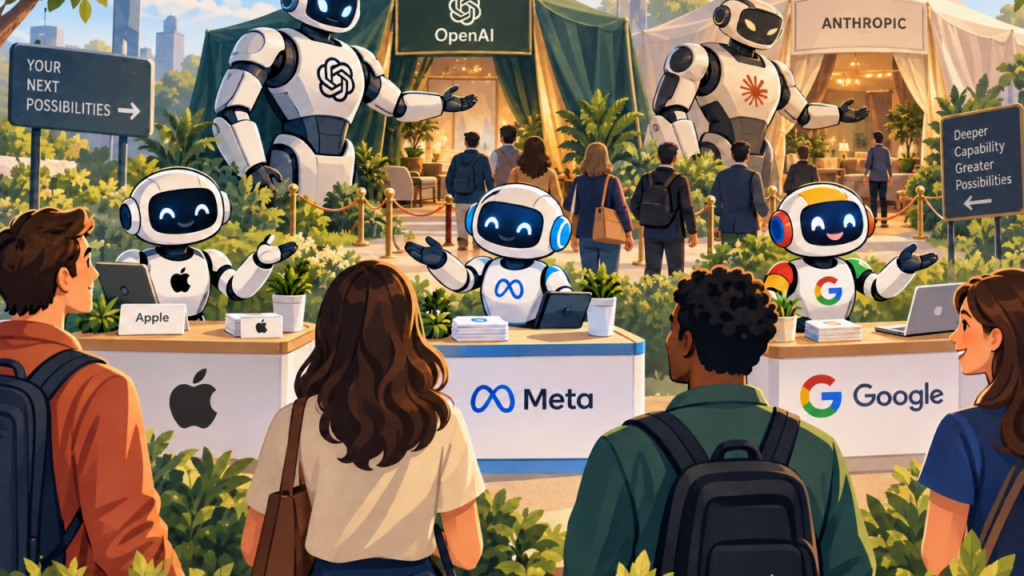
The more I think about this, the more I realize the important question isn’t about whether Siri beats ChatGPT, Muse beats Siri, or Spark beats everybody. The key is that Apple, Google, and Meta have the distribution to introduce personal agents to huge populations that might never have gone looking for one. They become enablers, while OpenAI and Anthropic can attract people who eventually want more.
Meanwhile, all five are racing toward the middle: the mass-market products are getting smarter, and the frontier products are getting easier to use. Collectively, they are creating a market that barely existed a year ago.
And that leads to the part businesses should be paying attention to. If hundreds of millions of people begin using personal agents regularly, the gateway to e-commerce starts to move. And, as Hemingway put it, I suspect the change will happen “gradually and then suddenly”. Today, companies spend enormous amounts of money trying to get consumers to visit a website, open an app, click a search result, scroll through a marketplace, or respond to an advertisement.
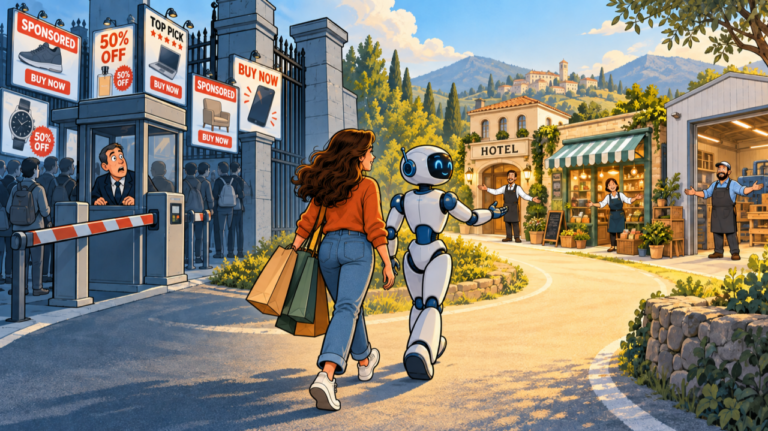
But over what I think will be months, not years, the customer’s agent will be sitting between buyer and seller.
That agent may decide where to look, which products make the consideration set, how alternatives compare, and eventually where the transaction happens. In the process, agents will become (and therfore replace) the aggregators in many of our product searches. That’s a huge change. So if you sell almost anything, you’ll have a new customer to worry about—not instead of the human customer, but standing directly in front of them.
Can the agent find you? Can it understand what you sell? Can it distinguish your product from somebody else’s? Can it get reliable information about price and availability? Can it transact with you? And, perhaps most important, when it compares you with everyone else, is there a good reason for it to choose you? These things are all achievable, but pointing a consumer’s agent to a website made for humans is likely suboptimal.
Siri doesn’t have to become the world’s smartest personal agent to help that future arrive. It may simply become one of the gateway drugs that gets millions of ordinary people hooked on having an agent in the first place. Google and Meta will be doing the same thing, while OpenAI and Anthropic wait further up the food chain for the people who decide they want something more. How you make yourself attractive to an agent will depend on what you sell, and I suspect every industry will develop its own tricks.
But the pitch that works on the customer may not work on the thing screening options for them first. We’ve spent decades learning how to influence people; now we get to learn how to influence their assistants without annoying the people behind them—and that should make a few marketing departments check whether their Xanax prescription has any refills left.