In March 2026, OpenAI confirmed it was transitioning Instant Checkout — the native in-chat purchasing feature launched in September 2025 — away from an OpenAI-owned checkout toward embedded merchant apps. An OpenAI spokesperson described the shift as “evolving our commerce strategy to better meet merchants and users where they are.” Instead of sitting in the payment flow and collecting a 4% transaction fee, they acknowledged some woefully underestimated difficulties with both consumers and vendors and decided to emphasize purchases either on the vendor’s website or through vendor apps within ChatGPT.
While the announcement was really about general retail, I’ve noticed a number of people in the travel industry insist on framing it as OpenAI openly acknowledging that travel is “just too complex for AI and Agents.” That is just so funny!
Travel: not the problem, never the problem
Travel isn’t too complex for AI. We just enjoy describing fairly ordinary complexity as if it were ancient mysticism. There are many hard problems in the world. Protein folding is a hard problem. Olympiad-level mathematics are hard problems. Medium-range weather forecasting is a hard problem. Designing advanced GPU chips for AI processing is a hard problem. AI has solved or contributed significantly toward solving all of them. Travel is mostly a pile of conditions and cancellation policies pretending to be one of them. In the grand scheme of things AI can help with, the complexity of travel is about a 2 on the 10 scale, and I think I’m being very generous here.
What actually went wrong
So if it wasn’t really about travel to begin with, and it wouldn’t have mattered if it was about travel, then what actually happened? Why did they retrench? In effect, they admitted that they didn’t do all of the preparatory work they really needed to get done for seamless retail transactions, so they’re going back to do it now. It seems OpenAI overestimated customer adoption of checkout in a brand new channel. This mirrors early e-commerce on the web, where people were initially very reluctant to put their credit cards into a web page. (I actually remember reading articles that said Italy – the whole country! – was a special case, and they might never adopt e-commerce. Good thing I didn’t take that one to the bank.) OpenAI also didn’t do a good enough job of explaining how this would impact merchants, and they neglected a few fairly essential items, like building in a sales tax collection system or real-time inventory synchronization across the retailers they connected to. Each of these would be a big deal, but if you add them up, it’s fair to say that their initial outreach was doomed from day one.
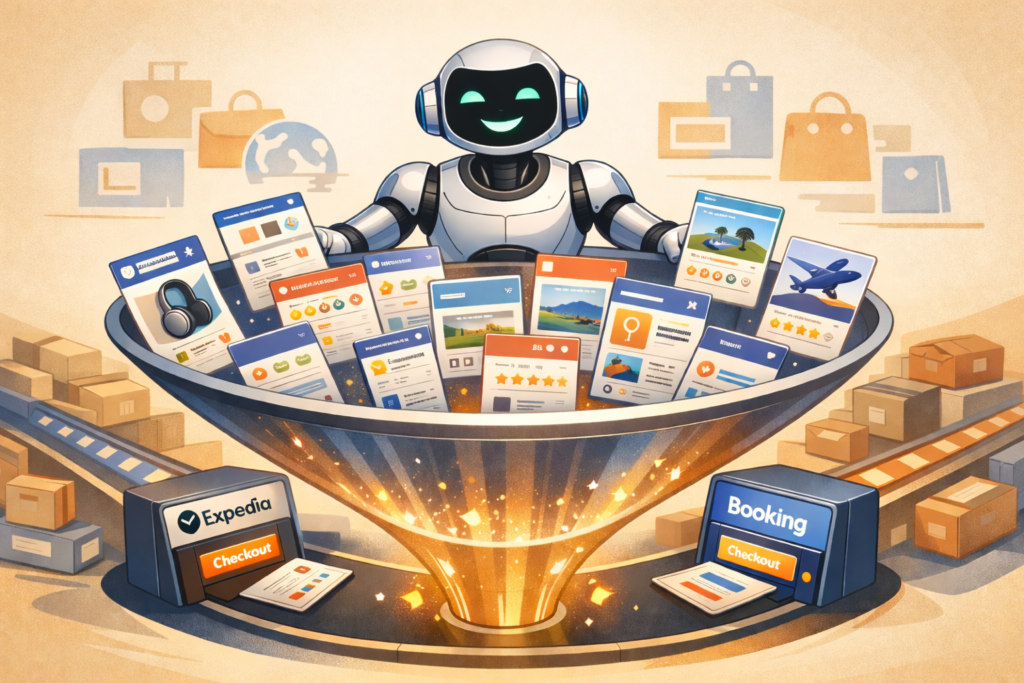
So what now? The upper funnel is still going strong. ChatGPT’s Shopping Research feature is available across all subscription tiers, including the free tier. It delivers highly personalized, interactive buyer’s guides with product cards, price comparisons, aggregated reviews, etc. You describe what you want conversationally, receive AI-curated and highly personalized (I know I’m repeating myself, but the personalization thing is key) recommendations, and then complete purchases either through embedded merchant apps (where Expedia and Booking have entries today) or by clicking through to retailer sites. ChatGPT’s Agent Mode can also navigate merchant websites autonomously to complete purchases. It’s horribly slow, but you don’t have to babysit it.
The upper funnel is alive and well
Why does this matter? Because it’s big biz! The market for AI-assisted retail commerce is growing fast and converting well. Adobe Analytics, which tracks over 1 trillion visits to U.S. retail sites across 100 million SKUs, reported that AI-referred traffic to retail sites grew 693% year-over-year during the 2025 holiday season (November–December), building on what was already a 4,700% YoY surge measured in July 2025 (Adobe Digital Insights, January 2026; Adobe Digital Insights, Q2 2025). More significantly, the quality of that traffic has flipped: AI referrals converted 31% better than non-AI traffic sources during the holiday season, with the gap widening on peak days (54% higher conversion on Thanksgiving, 38% higher on Black Friday). Revenue per visit from AI referrals rose 254% year-over-year, and AI-referred shoppers spent 45% more time on retail sites with 33% lower bounce rates (Adobe Holiday Shopping Report, January 7, 2026).
As an additional data point, Morgan Stanley projects the agentic commerce opportunity at $190–385 billion by 2030 for U.S. e-commerce (Morgan Stanley, 2025), while Amazon has provided the strongest single-company proof point: its Rufus AI shopping assistant has reached 250 million customers and is projected to generate over $10 billion in incremental annual sales (Fortune, November 2025).
Don’t bet against them
With all this on the table, you can bet that even if OpenAI is easing up on the gas, they’re definitely not taking their foot off the accelerator, let alone hitting the brakes. They went too fast, they screwed up, and now they’re stepping back to fix it. That’s it. Nothing more to see here, folks.
OpenAI and the broader group of AI labs have been defying the odds for the past three years. Every time we think they can’t possibly keep up the torrid pace, they double down, defying all the odds and coming back again and again like good gossip and bad judgment. If Polymarket were taking bets on OpenAI’s success in e-commerce, I’d take long odds in their favor.