This article is a continuation of the previous one that you can access here. The aim of the two posts is to paint a picture of what agentic commerce for hotels might look like in the near future. This reflects my opinion based on the research I’ve done, the conversations I’ve had, and my observations about how technology has unfolded in the travel world over the past few decades. Apologies for the length of this article, but I wanted to paint the whole picture from the supplier’s perspective without leaving anything important out.
As with the first article, I’ll start by noting some caveats:
- Even though I’m talking specifically about hotels here, the same principles apply to flights, ground transportation, activities, and all the other components we think of as constituents in a well-designed itinerary.
- I’m going to use ChatGPT as the example here because it has a unique combination of capabilities and also the largest chatbot user base among all the major models.
- While a lot is happening on the consumer agent side of the agentic commerce ecosystem, the supplier side largely represents an unfulfilled opportunity. In this article, I’d like to paint a picture of what I think hotels can uniquely do in agentic commerce to differentiate themselves, increase customer loyalty and satisfaction, and supercharge direct distribution.
- Agentic shopping is not going to replace your web shopping channel and, as we’ll see, some of the same things hotels can use to win in the agentic channels will also benefit their web channels.
Note: I’ll use the names of actual companies as examples in a few parts of this article. I have no financial arrangement with any of them. I’m offering them up to show that there are real companies in the space delivering these kinds of capabilities today. Not everything is TBD!
Phase 2: The Supplier Agent in Travel—Supercharging Direct Distribution Through Personalization
In the previous article, we focused on the consumer side, on the left of the diagram. Today, we’ll shift to the supplier side on the right and show how they interact. To recap, on the left side of the diagram, the objective is to establish the traveler’s intent—gathering all the bits of information from internal memory, from external memory, and from various resources out on the Internet to determine what the traveler needs and where to go looking for ways to meet them. Next, let’s look at the supplier side of the picture.
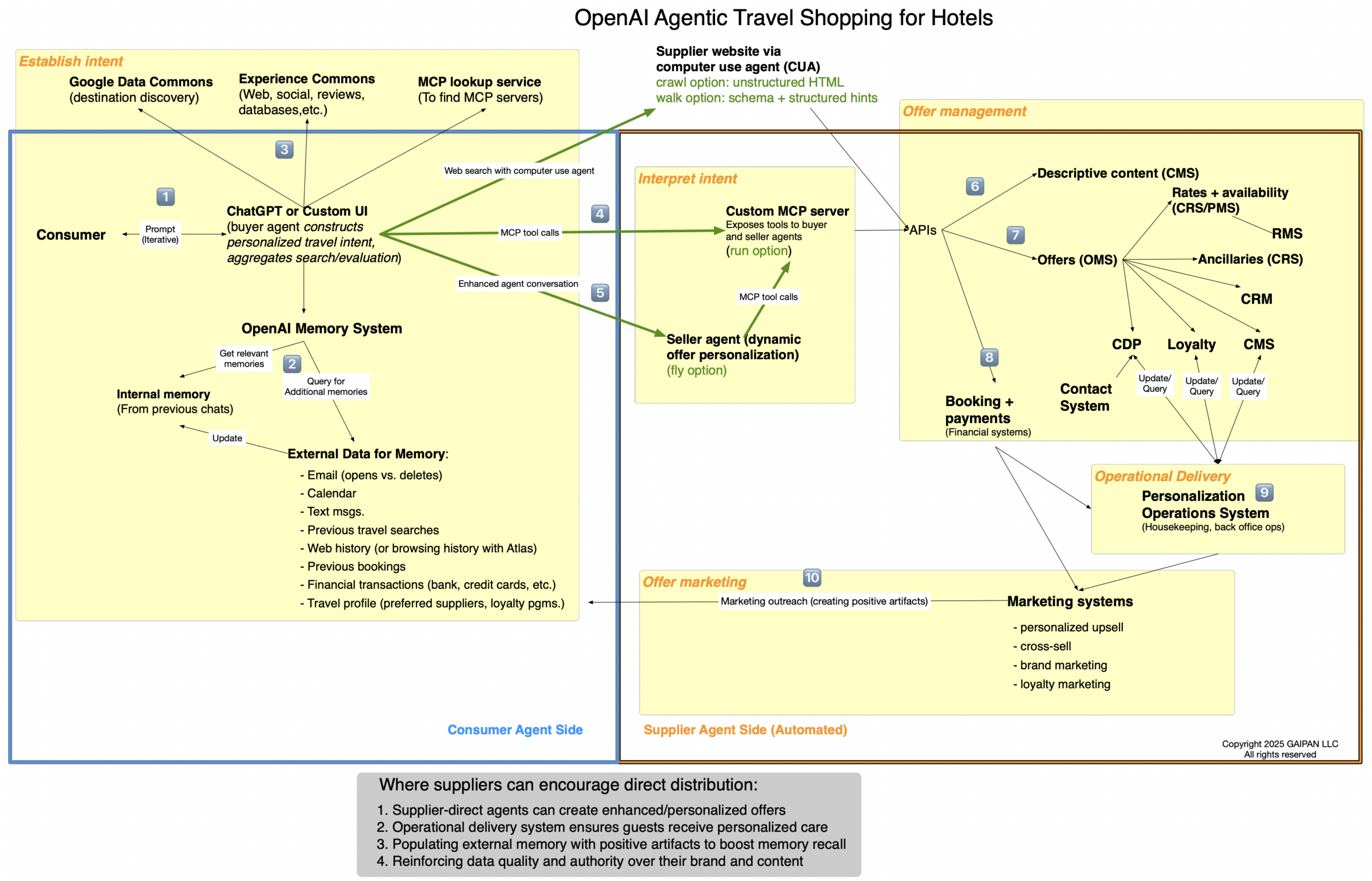
Where and How ChatGPT Searches for Hotel Information
We see three possibilities marked by green arrows coming from ChatGPT. This is where the supplier interprets buyer intent and prepares to respond with potential offers. I like to think of these as crawl, walk, run, and fly options—each representing increasing levels of sophistication.
1. Web search with computer use agent (crawl/walk options). These represent the bare minimum for agentic shopping; hopefully, you’ll treat them as a temporary solution while you implement something better.
The crawl option is to effectively do nothing. If an agent wants to shop your website and you’ve done nothing to prepare it for agent use, it will take its best shot at navigating around through a computer-use agent, mimicking human eyes and fingers to try and find what it can. If you’ve ever seen a computer use agent work on a computer, you know how painful it is for both the agent and the consumer. It’s like watching your grandmother use a self-checkout kiosk: a small tragedy in five acts, with the machine refusing to learn its lines.
The walk option involves creating a schema for each page to help the agent understand the information on each page and how to navigate it. This is a little better—like providing Cliff’s Notes for how to get what it needs from your site—but still just a placeholder for agentic consumption. (There is a recently launched WebMCP standard that can help here, though it still feels like adding duct tape to support an aging structure.)
Regardless of its usefulness in shopping, fixing your descriptive and ARI data on your website is incredibly helpful when an agent wants to figure out where to shop. For example, those familiar with Google Hotel Ads know that effective selling there requires establishing yourself as a reliable, accurate, and authoritative source of information. That first part applies to other agents, like ChatGPT, as well. They need to know where to shop and are looking for the best and most authoritative sources for your content. That benefit remains. But settling for the crawl or walk options means that agents might very well look to shop for your content with an OTA. That’s why OTAs have been so quick to implement MCP servers for agent access to their systems.
2. Searching via MCP tool calls (run option). This is the first alternative that truly begins to exploit the way agents operate. An MCP server is a piece of software that lists all of the different tools it has available and explains how to use them. In the context of agentic shopping for hotels, the MCP server:
- Exposes a standard tool interface so an AI client can securely call seller functions instead of relying on custom integrations. It’s a catalog of “here’s what I can do for you and what you need to know to get me to do it.”
- Makes your hotel “agent-ready” by exposing endpoints for things like search, availability, rates, book, modify, cancel, and keeps the underlying data clean, structured, and up to date.
- Is designed to be discoverable via registries or lookup services (so buyer agents can find it the way people look up websites via DNS). This refers to the MCP lookup service that an agent can call to find the MCP servers we noted at the top of the diagram in the previous article.
3. Searching through an enhanced agent conversation (fly option). While an MCP server supports agentic queries, an even better path is to construct a seller-side agent that can engage with the consumer-side agent and add a layer of intelligence on top of the MCP server. The seller-side agent:
- Represents the seller in the marketplace interaction: it’s the thing that responds intelligently when a buyer agent comes knocking, and it can exist at chain level, aggregator level, or property level. Hotels will want to make sure the agents come to the brand or property level.
- Makes choices and trade-offs the connection doesn’t define—e.g., what to offer, how to bundle/perk, when to be flexible, and how to compete (direct-only perks, richer content, etc.).
- Owns policy and identity (auth/scopes, and—more broadly—what the seller is willing to do for which authenticated traveler). You want to personalize offers for your best customers, identified by a frequent guest ID, that lets you know what they’re entitled to.
- Can extend beyond booking into operational actions (special requests, late checkout, etc.) and into the longer-loop marketing–memory flywheel (creating “positive artifacts” that improve future recommendation weight). More on this later.
How do the MCP server and seller agent fit together? The MCP server is the “how to call us and what we can give you” layer; the seller agent is the “what we do when you call” layer. In many implementations, the seller agent will sit on top of or alongside one or more MCP servers—using them as the standardized way to execute actions against the offer management system or PMS/CRS/loyalty stack, while the agent handles the business logic.
You can absolutely have an MCP server without a sophisticated seller agent (it’s still a solid agentic endpoint), but if you want to engage the more advanced personalization possibilities, you’ll need to build that logic into a seller’s agent or a smart offer management system. Eventually, seller’s agents will support negotiations with consumer agents, just like your human executive travel assistant might do on your behalf.
If you don’t have either, you’re just returning the traditional room type / rate plan combinations from yesterday. That works, but your personalization capabilities will be stuck in first gear.
Offer Management and Personalization
In steps 6, 7, and 8 we’re entering the traditional hotel tech stack where most hoteliers will feel comfortable with what each system does and how they interact. Some brands might have an offer management system pulling together information across a variety of resources, while others will create tools in the MCP server to call systems like CMS, CRS, and loyalty directly.
This is where things get interesting, because hotels have an opportunity to personalize the guest experience in multiple ways that OTAs and other distributors can’t. If it hasn’t been readily apparent up until this point, personalization is a primary driver of agentic commerce. It’s where agents can stand out to make the customer experience so significantly better than other channels that it’s difficult to imagine it won’t become a dominant method travelers use to plan and book trips.
The consumer agent comes into the process loaded with potential (i.e., traveler intent) just waiting for the supplier agent to respond with offers that match. This is an incredible opportunity for hotels to weaponize the channel against third parties and truly build a personal relationship with guests that extends beyond email marketing and advertising.
Creating Differentiated Guest Experiences via Personalized, Dynamic Offers
The default (and least differentiated) response to a buyer agent is to return the same room-type / rate-plan combinations you’d show an anonymous shopper on your website or via an OTA. That works, and it keeps the shopping in your direct channel, but it doesn’t give the traveler much incentive to book directly, now or in the future.
The first step up is loyalty authentication. If the traveler is in your loyalty program, an agentic request will very likely include their frequent-guest ID—so you can return member-only pricing and perks (late checkout, breakfast, etc.) that a third party can’t match.
From there, personalization gets more interesting: the buyer agent may express preferences that aren’t explicitly encoded in your standard room descriptions. A simple example is “quiet room.” Even if you don’t tag rooms as “quiet,” you can still satisfy the intent by selecting a courtyard-facing room rather than a street-facing one. If you don’t want to take the chance that the buyer agent will make that connection, you can put that intelligence into your seller-side agent or a smart offer management system.
If you support attribute-based shopping (ABS—you knew it was coming, right?), you can go further—matching at a much more granular attribute level and monetizing higher-value attributes (ABS is not just improving fit, but increasing revenue at the same time). You don’t need a full ABS implementation to get some meaningful benefit: a seller-side agent or smart offer/merchandising layer can infer attributes by scanning room-type and rate-plan descriptions and translating them into usable filters to provide a personalized offer.
By the way, that inference can also be done by an intermediary. For example, Nuitee, a distribution intermediary leaning heavily into AI, maintains and augments its own descriptive hotel catalog by extracting attributes from property, room-type, and rate-plan text with AI, then storing them for personalization matching. (Like in the quiet = garden view example above.)
Automated Operational Delivery of Personalized Experiences
A former colleague once told me about a time when he checked out of a hotel and the desk agent noticed him studying a painting hanging behind the desk. He remarked that it was really beautiful as he walked out the door. The next time he was in town, he chose to stay at the same property and was looking forward to seeing the painting again—but saw it was gone, replaced by another as he checked in. He was a little disappointed but shrugged it off until he opened the door to his room and stepped inside. The painting he’d been looking forward to seeing was hanging above the bed in his room. He also told me that from then on he always stayed at that hotel whenever he visited that city. The hotel made an effort to get to know him in a way that translated into a meaningful experience for him. There are lots of opportunities for doing this kind of thing in a hotel, but the problem has historically been operationalizing them. Let’s dive into some of those possibilities that don’t require buying great art.
AI can enable a second level of personalization that has nothing to do with what you sell and everything to do with how the stay feels once the guest walks in the door: room-level personalization that was either impractical or impossible to deliver consistently in the past. Not every hotel can do what my colleague observed, but the point is to show each guest that you’re making an effort to configure the room to be as enjoyable—for them personally—as possible.
When guests enter a room, they immediately start “configuring” it—usually without even thinking about it. Temperature, lighting, minibar check, workspace setup, housekeeping cadence, bedding/pillow preferences, bathroom amenities… the room becomes a living set of expressed preferences in about ten minutes.
The trick (and the opportunity) is to treat that as discoverable customization and turn it into repeatable operational delivery—so the next stay starts closer to “home,” without making the guest feel like they’re being watched. There are two paths:
- Explicit preferences: the guest tells you what they want, then you store it as a standing preference and apply it automatically for future stays (with an easy way to change it). Some hotels do capture a few preferences in a guest profile, though delivery can be spotty.
- Inferred preferences: the guest repeatedly changes the thermostat to 67°F, turns off the bedside lamps, never touches the minibar, always requests firm pillows, and consistently hangs the “do not disturb” tag on the door. Over time, you can treat those repeated choices as preferences as long as you’re thoughtful about consent, transparency, and giving them control.
This is where the seller-side agent story comes back around: if your seller-side agent can extend beyond booking into operational actions, then “operational personalization” becomes an implicit part of what you’re actually selling—because you can promise it and deliver it reliably.
And strategically, this matters because it gives you another lever—besides price and points—to pull travelers back into your direct channel.
This is the part where hoteliers roll their eyes and say: “Sure, great theory. But I run a portfolio of hotels, not a Ritz with a binder of index cards.”
They’re not wrong. “Personalization” of any kind only becomes a real competitive advantage when you can deliver it—consistently, across properties, without adding headcount or creating chaos for housekeeping and engineering.
That’s why it helps to separate two different kinds of personalization:
- Offer personalization (pre-stay): what you sell and how you package it (room, rate, perks, bundles). We covered this in the Offer Management section above.
- Operational personalization (in-stay): how you deliver the stay before the guest arrives—how the room is set up, how it’s serviced, and how the hotel “remembers” what matters to that guest without being weird about it.
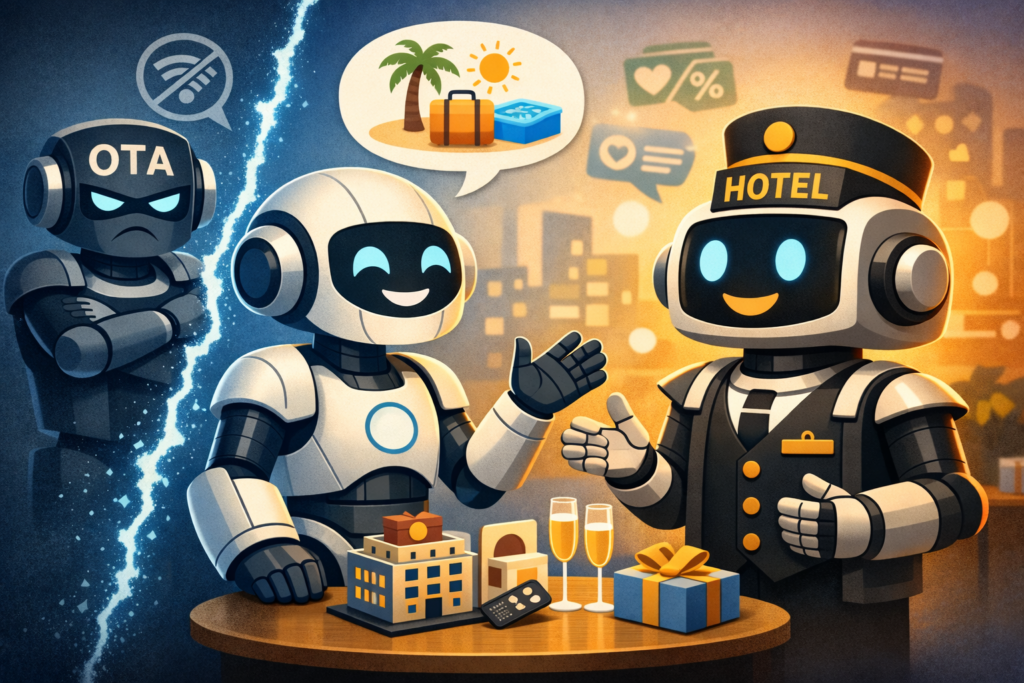
The second one is where hotels can create another significant advantage over aggregators, because OTAs can help someone book a room, but by treating the traveler as exclusively their customer (and withholding their identity), they block the hotel from delivering a personalized stay. This communicates to the guest: if you want everything the way you like it, you’ll have to book direct.
A new piece of the hotel tech stack: a personalization operations system
In the absence of that killer index card system, hotels need something that knits together each guest’s preferences with the logic and communications to deliver them. An example of this kind of system working today is offered by Levee, which sits between a desired room state (how the room should be configured at a particular point in time) and hotel ops, and turns brand and hotel standards into a checklist the property can actually execute.
Levee makes personalization practical by treating brand standards (and in the near future, guest preferences) as work that must be executed and verified. Today it can ensure that the bed is properly made, the minibar has the recommended contents, and the bathroom has the right number of amenities. Tomorrow that same system can be used to ensure that guest preferences become part of that desired room state. It can ensure that “hypoallergenic setup + extra towels + crib + firm pillows” appear as a work order that must be delivered prior to check-in.
What Levee does is give those the attributes of a desired room state a structured home where they can be parsed, assigned, and acted on. A pre-arrival execution plan spanning housekeeping and engineering, with tasks dispatched, tracked, and closed out as part of the same room-readiness workflow. The preferences aren’t sitting in a text field hoping someone reads them, they’re work orders.
This bridges the gap between “we told the team” and “it happened”, a gap that anyone who’s worked in hotel operations knows is where personalization promises go to die. Over time, this creates a tighter operating loop where the hotel learns which instructions and standards reliably produce the desired outcome across shifts and properties, rather than relying on a few heroic managers to will it into existence.
At the executive level, the strategic implication is that personalization becomes a repeatable, portfolio-scale capability. Levee’s longer-term direction is explicitly aligned to becoming an OS that can route work across humans, AI, and robots. (How cool would it be to have Rosie the Robot deliver your extra pillows!) That’s what turns personalization from a marketing promise into something that can be delivered reliably under labor pressure. Done right, that operational backbone becomes the prerequisite for the broader personalization flywheel.
The Marketing–Memory Flywheel (Where Personalization Turns Into Future Demand)
Here’s the part many people miss when they think about “personalization” in agentic commerce: it doesn’t end at the booking, and it doesn’t even end at checkout. Done right, personalization throws off data exhaust that becomes marketing fuel—and marketing, in turn, creates the “positive artifacts” that make buyer agents more likely to bring you the next booking. What goes around really does come around.
Let’s pause here a minute, because this is an incredibly important part of how to exploit agentic shopping to keep your best customers coming back again and again. On the web, hotels have been trained to use advertising and OTA incentives to gather attention when guest come shopping. But agentic channels aren’t driven by human attention. They don’t respond to any of the traditional attention-grabbing tricks.
OpenAI and many other models (except Google and Meta) have definitively stated they won’t let advertising impact their recommendations to the consumer. OpenAI and X.ai state this outright, Anthropic doesn’t accept ads, and Perplexity recently stopped presenting ads to avoid the controversy. Ads and other commercial incentives with these companies have no effect on their chatbots. So how do we influence the chatbots? I hope the path is clear in the diagram, by feeding back directly into the external data for memory in step 2 and experience commons in step 3! There is a reinforcing loop we can complete here, a flywheel that we can track as follows:
1) Pre-stay offer personalization matches buyer intent signals. When a buyer agent shops your hotel and you respond with personalized, dynamic offers, the guest’s choices become extremely valuable signals—which perks they selected, which attributes they cared about, what they almost bought but didn’t. You’ve not only responded with offers the traveler is most likely to want, but those signals, and previous interactions, can be routed into your marketing stack before arrival—so pre-arrival upsells aren’t random “Want to add breakfast?” spam, but nudges tied to what the guest already indicated they value.
2) In-stay operational personalization creates preference signals. Once the guest is in the room, they start configuring it. If you treat that as discoverable customization (with the right guardrails), it becomes a second stream of signals—what they consistently adjust, what they ignore, what they request or complain about through service channels. Those in-stay signals can flow into marketing systems, not just ops—so the next time you sell to that guest, you’re doing it with a real understanding of what matters.
3) The hotel already has plumbing to support this. Big hotel groups already capture service interactions across phone, email, chat/SMS/WhatsApp, and social channels. When you can identify the guest (loyalty ID, reservation number, email, phone, etc.), those signals can attach back to a real guest profile and be used in an offer management system for the next time the guest appears in a shopping request.
4) Marketing creates the signals that buyer agents are looking for. This is where the loop closes. After a great stay—especially one that feels tailored to the guest’s needs, your engagement with the guest through email confirmations, text messages, etc. creates positive artifacts that are absorbed back into their External Data for Memory, elevating you in the memory hierarchy for future hotel searches.
At the same time, those positive experiences can nudge the guest to leave behind the kinds of positive artifacts that matter in an agentic world: reviews with specific attribute praise, social posts, like “great lap pool,” “perfect for remote work,” “quiet rooms,” “excellent vegetarian options,” etc.. that surface in Experience Commons searches.
Aha, you might think, so if I just flood the zone with email marketing I can elevate my brand in chatbot memory! Not so fast. That makes you like the vendor who tries calling a prospect every day and always gets intercepted by their executive assistant telling you she’s out of town. You’re not getting through because the signals aren’t high quality, just high quantity and, eventually, just annoying. As with a human EA, I wouldn’t be surprised if the annoyance of continually stuffing the email channel makes a traveler’s agent specifically downgrade your status in external memory. Spamming becomes damning.
5) This also changes loyalty marketing. In the old model, loyalty marketing was mostly about points, email marketing and, very occasionally, a bit of personalization.
In the agentic model, loyalty marketing becomes something a little broader:
- Offer personalization helps win the booking.
- Operational personalization helps win the guest experience.
- Marketing helps turn that win into durable, external proof of a great experience—so buyer agents weight you more heavily next time.
That’s the flywheel: personalization drives a better stay, the better stay generates better artifacts, and those artifacts make the next recommendation more likely—without you having to “buy” the demand back through an intermediary.
Summarizing Where Suppliers Can Encourage Direct Distribution
If you zoom out, the playbook for winning direct in an agentic world isn’t just “build another booking path”—it’s to make your hotel the easiest property for a buyer agent to confidently choose. You do that by:
- Reinforcing data quality and authority over your brand and content so agents know where to shop. Really, you should have been doing this all along even for the web. If you’re still not making sure your data is clean
- Using supplier-direct agents to create enhanced, personalized offers that OTAs and other third parties can’t match.
- Using an operational delivery system to ensure guests receive personalized care during their stay.
- Populating your guests’ external agent memory with positive artifacts to boost memory recall of your property/brand and beef up Experience Commons searches.
Answering the Questions We Started With
In the first article, I said we’d examine four questions:
- How will Agentic channels work for hotels in particular? They work by matching deeply personalized traveler intent (built from memory and context) with equally personalized supplier responses delivered through MCP servers and seller-side agents.
- Will people really want to use them? Yes, because the experience of having a supremely talented executive assistant who knows your preferences and advocates solely for you is fundamentally better than clicking through grids of rooms on a website.
- How can and should I participate? Start with data quality and schema markup (walk), move to MCP server implementation (run), and eventually build seller-side agent intelligence with personalized offer management (fly). At the same time you can be building your Personalization Operations System to ensure that your guests have a superior experience through all direct channels.
- Do I really have to get involved now? This is the critical question. The flywheel is going to build over time for first movers. The defaults for now will be providers of supplier data who have the strongest content plus MCP servers or seller agents to interpret intent. As of today that’s mostly the big OTAs, and that makes them the default search space for models like ChatGPT and Gemini. But it needn’t stay that way. Hotels have the ability to move that demand from the OTAs to direct distribution by making themselves the best place for an agent to shop, and the sole purveyors of the kinds of highly personalized options only suppliers can provide, while the defaults are still malleable.
The OTAs are hoping hotels will proceed cautiously, like they did with the web.
It’s not too late. Let’s not wait until it is.