It’s springtime, the season when nature trots out a new round of progeny for many different species, including, apparently, those of the world’s largest technology companies. It’s not like it’s been an understated winter for the tech titans: companies like OpenAI and Anthropic have been duking it out for model supremacy for many months. But the new crop that appears to be coming out now is focused on personal agents, the “one agent to rule them all” that many people said would never see the light of day.
Well, it looks like that light of day is upon us and shining very brightly.
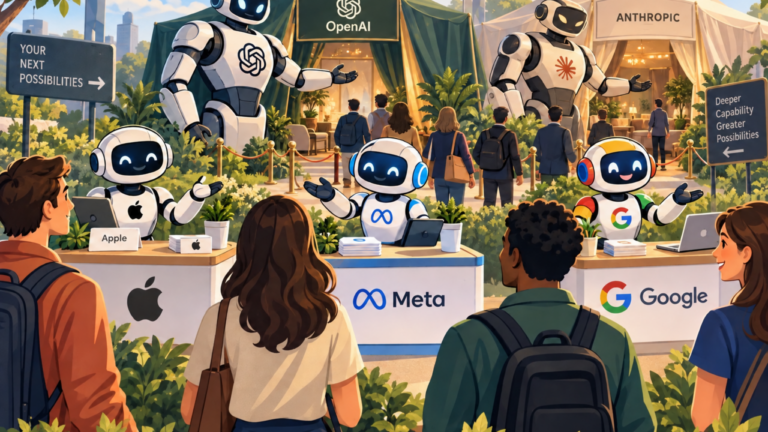
Lots of companies want in on personal agent mania. OpenAI hasn’t said much yet, but by hiring the inventor of OpenClaw, it’s clearly signaled its intent. They need a big splash, and with over 900 million weekly active users, the timing couldn’t be better. Anthropic has also been silent, but a recent code leak showed that they have their own personal agent, Conway, in development as we speak. Meta is reportedly building a consumer agent called Hatch, with a premium tier that could run up to $200/month.
At its recent I/O conference, Google announced enhancements to its Gemini Spark personal agent, and even Microsoft, at its Build conference this week, rolled out its own family of in-house models that customers can fully customize to their business, along with Copilot agents built for the workplace. The biggest giveaway that this is being viewed as a huge market will come next week when Apple makes what has become its annual AI walk of shame into the auditorium at WWDC 2026.
That’s when they’ll tell us once again how close they are to bringing out a magical new personal agent in the form of a dramatically enhanced version of Siri. Will this be the year that actually comes true? Based on the rumors, all indications are that they and Google will have something worth taking a look at. Apple desperately needs to pull a rabbit out of its hat, and, apparently, they may have located a rabbit that’s up to the task.
Really? Believe me, I’ve been as skeptical as anyone. For years, they’ve been applying their traditional wait-and-see attitude to a technology that punishes those who wait. A.I. moves faster than any technology I’ve ever seen, and the ones who have done the best are those who got on board, made their mistakes, and learned how to harness it early.
From my perspective, this dealt very heavy blows to Apple. The first was that by failing to build competitive frontier models early on, they may have saved some money, but they also took themselves out of that race, leaving it up to others to learn how to create the most productive technology ever. The second blow came when OpenAI announced its new memory feature back in 2025.
It doesn’t take a rocket scientist to see that memory, properly implemented, would enable chatbots to become deeply personalized to their users, and that would make them incredibly sticky during normal use.
The most consequential technology in many generations, highly personalized to each individual user, and available to anyone who wanted it. You’d have thought Apple would want to get in on this, but their head of AI (who thought chatbots were for losers) and their head of finance (who thought they could save money by funding it on a shoestring) thought otherwise, and it took a few very public shamings to get rid of those guys and get back on track.
It’s all well and good to be contrite, but you might ask how Apple could possibly recover from mistakes like that. Well, I can only say that my path to the aha moment took me on a journey with the Greeks, or, to be more precise, a line of wisdom from the movie “My Big Fat Greek Wedding.” You probably already know the one, but for those of you who haven’t heard it, the line is spoken by Toula’s mother, Maria Portokalos. The exchange goes:
Toula: “Ma, Dad is so stubborn. What he says goes. ‘Ah, the man is the head of the house!’”
Maria: “Let me tell you something, Toula. The man is the head, but the woman is the neck. And she can turn the head any way she wants.”
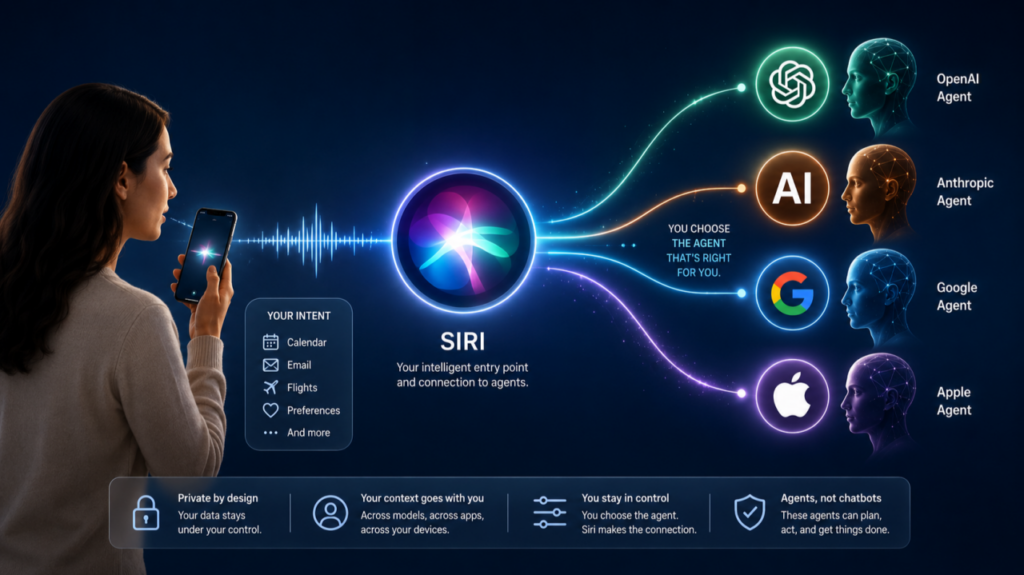
And that’s what I firmly believe Apple will introduce to us next week: their ‘neck’ strategy. To put a fine point on it, I don’t believe they’ll actually be turning the user to select any particular model; they’ll just be the swivel that gets them where they want to go, including their own models plus the ones from Google.
Apple can’t compete in the model-building category, so they’ve aligned with Google to provide something not really on the leading edge in terms of intelligence, but certainly ‘good enough’ for many people.
Before you dismiss the ‘good enough’ sentiment, my only point is that hardening and testing a model to run inside Apple’s private environment takes months, and in a market where the frontier moves every few months, “good enough but a generation or two behind” isn’t a temporary state; it’s a structural disadvantage they’ll have to contend with going forward. But that lag is exactly why being the neck beats trying to be the head.
When a question needs serious horsepower, Siri can route it to whichever frontier model the user prefers and keep its own good-enough model for the lighter, more private work where a generation behind doesn’t really hurt. So Apple will let other companies build the head (frontier models) while it works to become the entry point (neck) for those heads.
Still not seeing it? Think of it this way: if users pick up their phone and launch an agent app like ChatGPT or Claude, Apple becomes just a device, a carrier for the important stuff being done by agents they facilitate. But if they can get users to pick up their phones and invoke the new, not-brain-dead version of Siri to call those agents, then the game changes dramatically.
How do they get users to make Siri the first port of call instead of the agents themselves? Once the neck strategy appeared, here’s the list I came up with.
- Default/inertia. We all know how powerful defaults are. People value convenience very highly, and nothing is more convenient than doing nothing at all. So if Siri can engage with any external agents (and I believe we are going to see that next week), it can become a kind of universal entry point that requires little or no setup. Remember that Apple will provide its own models in addition to Gemini with no setup.Of course, they’ve also built up the habit of users to automatically ignore/distrust Siri over the past two years, so it’s not a foregone conclusion they’ll give it a second chance.
- Cross-model memory. Another obvious version of Apple’s promise would be: ask through Siri, and your agent memory follows you, regardless of which model answers. Today, if a traveler uses ChatGPT for restaurant research, Claude for itinerary planning, Gemini for local discovery, and a travel brand’s agent for booking, their preferences fragment across providers.Apple can offer a memory layer that sits closer to the user, carried across models and across devices, including preferences, loyalty memberships, dietary needs, family constraints, seating preferences, risk tolerance, etc.
- Model switching. A user could set a default model but switch to a specific model for different queries. They could use Gemini for one task, Claude for another, ChatGPT for another. Siri becomes the interface for choosing, routing, and remembering across models, a capability that no individual model provider can currently offer.
- Multi-model querying. Siri could send the same prompt to several models, return the responses, and compare the results. For high-value decisions, this could be extremely useful. “Ask these three models about this topic, compare the logic, and tell me where they disagree.” OpenAI, Anthropic, and Google can each run their own model. Only a neutral entry point like Siri can run a comparison.
- Context stuffing. Apple can attach calendar, location, wallet passes, email confirmations, messages, maps, app state, loyalty apps, and device context to any outbound request. The external model receives a richer prompt than the user would have written on their own. For travel, the benefits of this are obvious.
- Cross-device operation. Start on iPhone, continue on iPad, finalize on Mac, receive disruption support on Apple Watch. Most frontier models span several devices, but none span the entire Apple ecosystem.
- Future model optionality. If Apple gets the neck strategy right, it preserves the option to build or acquire a frontier model in the future. The harness, the memory, the user relationship, and the cross-model routing would already be in place because Apple will have been listening in on all the conversations between users and all of the models that go through Siri.Each model can build memories of any conversations it has with a user, but Siri could build up a consolidated memory system across all of them.
All of this is, as the ancient Greeks used to say, “Wicked Cool” but Apple could still mess it up. One thing they’ll still have to avoid from their past bad habits is trying to become the controlling parent figure. I do believe people are concerned about privacy, but they also want to relax that privacy when they feel it’s warranted.
What this means for travel
Travel is one of the industries most exposed to personal agents. Travel decisions are complex, time-sensitive, and emotional. A good travel agent, human or AI, becomes valuable when they remember the traveler and can act accordingly.
If personal agents become the new entry point for travel planning, the travel funnel changes.
A traveler may not search for “best hotels in Lisbon.” They may ask their agent: “Find a hotel my spouse will like for the Lisbon part of the trip, keep it under our usual budget, avoid places that feel corporate, and make sure we can walk to dinner.” The agent will decide where to look, which suppliers to trust, which reviews matter, which loyalty programs to consider, and whether the traveler’s prior behavior should contest something in the current request.
I don’t know exactly what Apple will announce next week, or what they’ll decide to do and not announce, but we have to read the tea leaves and make an educated guess. Apple, OpenAI, Anthropic, Google, Microsoft, and Meta are all racing to build or own the best personal agents. With that much effort and capital flowing into the space, they will draw a large share of consumers into the personal agent fold.
Suppliers need to double down on getting ready for agentic shopping as quickly as possible, though the addition of a new Apple agent won’t necessarily require any additional work beyond what you do for other agents.
Getting ready will take some meaningful work. It not only requires building agent-friendly technology to interact with personal agents (and serious bonus points if that includes not only an MCP server but also an offer management system). Remember that if you make that special offer and it’s accepted, now you have to deliver on it. If you don’t have the right offer for a potential guest shopping through their agent, you may lose the booking.
But if you make an offer and then fail to deliver on it, you could lose a customer.