TL;DR
- Block CEO Jack Dorsey cut 40% of the company’s workforce in February, then co-published an essay with Sequoia’s Roelof Botha arguing that AI can replace the information-routing function of management hierarchy entirely. The layoff made the news, but the essay is what really matters for most of us.
- The concept at the center of the essay, a “world model” that coordinates an organization through a structured ontology rather than through layers of managers, isn’t new. Palantir and Anduril have been building world models for defense customers for years. What’s new is that current AI models are powerful enough for non-defense companies to attempt it.
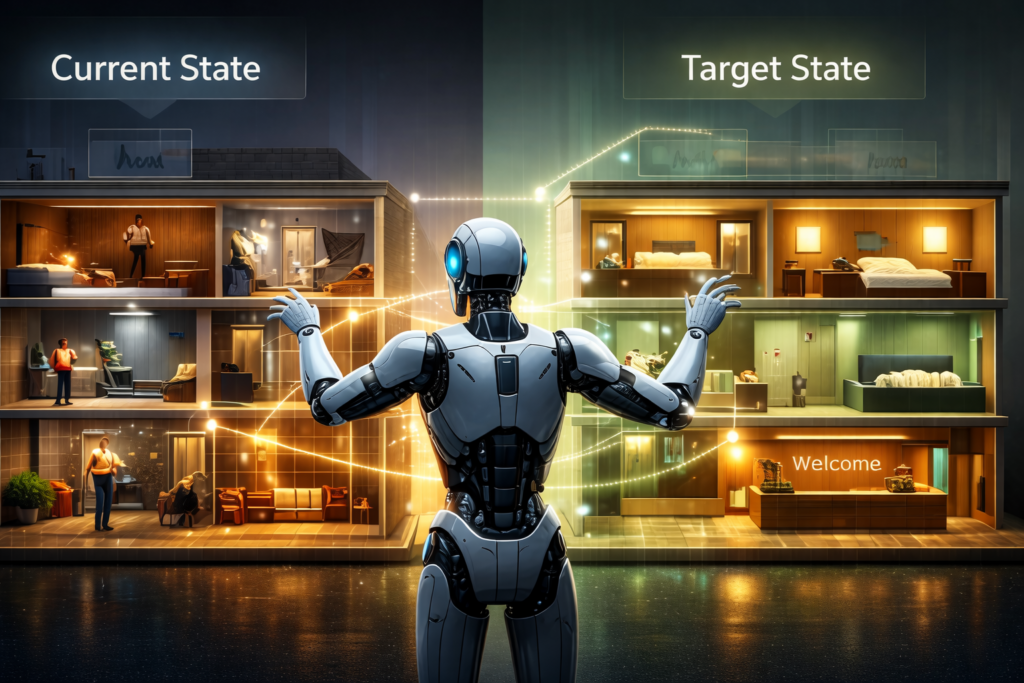
- An ontology is the schema: what entities exist, how they relate, what rules apply. A world model adds the dynamic layer: current state, target state, gap detection, and actions. The ontology tells you what a hotel is. The world model describes what it’s doing right now and what it should be doing.
- Hotel operations are a natural fit for an explicit ontology because they have well-defined entities (rooms, staff, guests, equipment), structured relationships, and strict definitions of what “good” looks like. An ontology applied between a digital twin that mirrors the current state and a target state derived from SOPs and guest preferences enables automated gap detection, task dispatch, and auditable accountability across systems — something no PMS vendor has been able to deliver because their applications are siloed.
- Going beyond the back of house, the operational world model connects to agentic commerce post-booking, not at the point of shopping. It’s what enables a property to actually deliver on what was sold. Over time, consumer agents will track delivery reliability, and properties that can prove they fulfill commitments will build compounding reputation signals in the agentic distribution channel. Delivering on property what you sold online builds loyalry.
- AI-native new entrants will organize around world models and use agentic engineering to build faster and cheaper. Incumbents don’t need to transform their entire organization, but they do need to pick a bounded operational domain, build a world model for it, and start learning. Soon.
On February 26th, Block CEO Jack Dorsey cut roughly 4,000 employees, reducing the company’s workforce from over 10,000 to under 6,000. Why? Because he (and presumably others at Block) felt that intelligence tools had changed what it means to run a company. The stock surged more than 20%. Wall Street loves a good layoff.
A month later, on March 31st, Dorsey co-published a much more consequential piece with Sequoia’s Roelof Botha titled “From Hierarchy to Intelligence.” That one barely moved the stock, but for those of us not holding Block shares, it deserved much more attention than the layoff. It describes how a company can swap out its management hierarchy for an AI-powered coordination system, and even if you think Block is overselling it (fair), the core idea has legs — particularly for hotel operations.
The Core Argument
I’ll keep this short because the essay is worth reading in full. Dorsey and Botha trace organizational hierarchy from the Roman legion through the Prussian General Staff to Daniel McCallum’s 1855 org chart for the New York and Erie Railroad. What ties it together is that every layer of management exists because one person can manage only three to eight others. Every experiment in organizational design since McKinsey’s matrix, Spotify’s squads, and all the rest tried to work around that constraint. None of them stuck at scale. Organizations always snap back to hierarchy because nothing else could handle the information routing. We. Were. Trapped.
Block says AI breaks that constraint, that we finally have another option. Instead of humans carrying context up and down a chain of command, a continuously updated “world model” (more on this below) of the company’s operations provides that context to everyone at the same time. Block sees both sides of millions of payments daily through Cash App and Square, so they pair an internal company world model with a customer world model built from all that transaction data. The system creates financial products for specific customers at specific moments without a product manager drafting a roadmap. (Product managers take heart: while this is great for smaller, incremental innovations, the big inventions that earn you the big bonus are still squarely in your wheelhouse to discover.) With the world model in existence, the org structure collapses to three roles: individual contributors who build, directly responsible individuals (DRIs) who own specific outcomes on 90-day cycles, and player-coaches who do hands-on work while developing people. No permanent middle management. (I’d like to say something Shakespearean here but my wife thinks it would be tasteless.)
Both Things Are True
Before we go further, let’s deal with the obvious question: is this real, or is it cover for a post-COVID correction?
The skeptic’s case is pretty obvious. Block’s stock had fallen more than 70% over five years before the layoff. The company nearly tripled headcount during COVID. In March 2025, just eleven months earlier, Dorsey cut 931 employees and explicitly said the cuts were “not about replacing folks with AI.” Then the framing reversed entirely. Wharton’s Ethan Mollick questioned whether a firm-wide 50%+ efficiency gain from tools this new is even plausible. Former Block employees told reporters that roughly 95% of AI-generated code changes still require human modification. And Dorsey spent $68 million on a company-wide party five months before cutting 4,000 people. That one’s hard to walk past. Marie Antoinette at least had the excuse of not knowing what was coming.
I think both things are probably true at the same time. Block overhired during COVID and needed a correction. And the Dorsey-Botha framework contains genuinely important ideas that will outlast whatever happens to Block’s stock price.
Why do I believe that? Because what they’re describing isn’t actually new. It’s new to most of corporate America, but companies like Palantir and Anduril have been building something very similar for defense and commercial customers for years. The difference is that until recently, the AI models weren’t powerful enough for anyone outside the defense-industrial complex to attempt it. That changed around December 2025, and Block is among the first non-defense companies to act on it. They’ve been testing internally for about three months. It’s not complete, it’s not perfect, but the pattern has serious precedent.
So you have a choice. Wait until this is fully proven and widely adopted. Or recognize that the concept has legs and start figuring out what to do about it. I’m arguing for the latter — not because Block has all the answers, but because the architecture is sound, the enabling technology is here, and the companies that move first will open a structural advantage that’s hard to close.
Ontologies and World Models
Most of the commentary on the Dorsey-Botha essay has focused on the layoffs and the death of middle management. The more important idea has gotten far less ink: the role of what they call the “world model.” Strip away the org chart stuff, and what they’re actually describing is an architecture built on two components that are worth pulling apart. I know you hate the new jargon, but think about what this will do for the caliber of your chit-chat at future cocktail parties.
The first is an ontology: a structured, machine-readable representation of an organization’s entities, their relationships, their attributes, and the rules governing them. If you’ve never heard of an ontology, you’re in good company. Outside of defense contractors and philosophy departments, almost nobody uses the word. Think of it as the schema — the blueprint that defines what things exist, how they connect, and what rules apply. Once again, in case you’re trying to skip this part, the ontology is a description or blueprint of something, not the something itself. Ontologies are super important because once you have that blueprint described, you can do all kinds of things with it, not just what Block chose to do.
The second is a world model, which takes the ontology and adds a dynamic layer on top: current state, target state, predictions, simulations, and actions. The ontology tells you what a hotel is, what it’s composed of. The world model tells you what it’s doing right now and what it should be doing.
Palantir and Anduril, the companies with the longest track record here, have built world models, not just ontologies. Palantir’s Foundry maps a client’s business into a structured schema/ontology and orchestrates actions based on rules applied to that structure. Anduril does something similar for military theaters: mapping terrain, assets, threats, and sensor data into a real-time model that supports autonomous decision-making. Both layer current state, predictions, and actions on top of the structural schema. Same ontology concept, but parlayed into very different kinds of world models.
Block’s version is architecturally similar but differs in one important way: how the ontology gets built.
Palantir builds ontologies deliberately. Consultants and engineers map a business into a formal structure. Top-down, expensive, explicit. Block’s world model is inferred. Because Block is remote-first and generates machine-readable artifacts from virtually every action — code commits, design documents, decisions, communications — the ontology forms bottom-up from operational behavior. Nobody sits down and maps the company into a schema. The schema emerges from what people do.
Let’s call the Palantir approach an explicit ontology and the Block approach an implicit ontology. We need to separate them out because they have very different prerequisites for building one.
An explicit ontology requires deliberate modeling, domain expertise, and upfront investment. It works when the domain is well-understood, relatively stable, and benefits from formal rules. An implicit ontology needs a high volume of machine-readable operational artifacts, so it works best in digitally native organizations where work generates structured data as a byproduct. Block’s remote-first, artifact-heavy culture is a natural fit. A hotel where the front desk manager communicates by walkie-talkie is not.
But the two aren’t mutually exclusive. You could start with an explicit ontology for a part of the organization and, as operational data accumulates over time, develop an implicit layer on top of it. The explicit ontology becomes a kind of scaffold; implicit patterns grow as the system learns from what actually happens. This is most likely how hospitality applications will work. At least at first.
Why Hotels, and Why Operations
For travel, the question right now isn’t whether to flatten your org chart. It’s whether this same approach can work for hotel operations. I think it can, and operations is exactly the right place to start.
Hotel operations are fertile ground because operations have strict definitions of what good looks like. A hotel is a collection of well-defined entities: rooms with specific attributes (type, floor, view, condition, housekeeping status), staff with defined capabilities and schedules, guests with preferences and history, and processes governed by standard operating procedures. The relationships between these entities are structured and largely rule-based. The gap between what’s happening and what should be happening is “computable.”
If you’ve been in this industry long enough, you’ve heard this pitch before. Every major PMS vendor — we don’t need to name names — has promised some version of “smart hotel operations” for years. Real-time room status. Dynamic staffing. Guest preference matching. Predictive maintenance. The features keep showing up in vendor roadmaps. They keep underdelivering.
Why? Because none of it works when you have a collection of siloed applications with different aims, each trying to control its piece of the environment. The PMS knows about rooms. The housekeeping app knows about cleaning schedules. The maintenance system knows about work orders. The CRM knows about guest preferences. None of them share a common understanding of what the hotel is right now or what it should be. They’re all talking. Nobody’s listening to each other. And even if they did, trying to automate hotel operations using rules is a one-way ticket to madness and disappointment, depending on whether you’re on the vendor side or the hotel side. This is a big part of the reason Block determined that basing its company’s operations on a world model has only been workable for the past few months. The reasoning and action layer sitting on the ontology wasn’t smart enough before.
This is what an ontology and world model actually fix. The ontology maps the applications, the data, the entities, states, relationships, rules, and actions into a unified ontology. The world model sits above the individual applications as a coordination layer. It doesn’t replace the PMS or the housekeeping system — it provides the common operating picture that none of them can provide on their own.
And here’s why this time is different from years of vendor promises. An ontology applied between a digital twin of the hotel’s current state and a target state derived from SOPs and operational standards means you can, for the first time, have an automated agent that senses the gaps between the two, determines corrective action, issues tasks to the right staff, monitors completion, and audits the entire chain.
That last part is where hotel executives should really pay attention. Management at the property, brand, and chain level gets visibility not just into what happened, but what didn’t happen and who was responsible for making it happen. When a guest’s firm pillow preference doesn’t make it to the room, you can trace where the process broke. Was the preference in the system? Was the task issued? Was it completed? If not, why not, and by whom? That kind of operational accountability has never existed at the property level because there’s never been a coordination layer capable of tracking it across systems.
Hotel operations are chaotic. Guests change plans. Equipment breaks. Staff call in sick. That chaos is what makes a world model valuable — detecting gaps between current and target state in real time, figuring out how to address them, and dispatching people via defined tasks to bring the property back to where it should be. The chaos isn’t a bug in this approach. It’s the use case.
And before this starts sounding like a boil-the-ocean initiative: an explicit ontology for a single hotel property is a bounded project. You’re modeling a few hundred entity types — rooms, staff roles, equipment, menu items, guest segments — their attributes, and the rules connecting them. For a hotel, the ontology becomes a template you instantiate for each property, with local variations. It has a recognizable project shape.
I’m aware of early-stage work applying an explicit ontology to hotel operations along exactly these lines. This isn’t hypothetical.
The Connection to Agentic Commerce
If you’ve been following my previous writing on agentic commerce, MCP servers, and the shift from search-based discovery to agent-based consumption, the obvious question is how the hotel world model connects to distribution. I hinted at it before, but here’s some additional detail.
Not at the point of shopping. When a consumer agent shops for a hotel on behalf of a traveler, it queries availability and rates from the CRS, same as today. The hotel might or might not have a room that matches a specific attribute request, but overbooking practices mean that even confirmed bookings carry some risk that what was sold isn’t currently available.
Where the world model matters is post-booking, in operational fulfillment. Once the booking lands, the world model enables the property to deliver on what was sold. The gap between “we sold a quiet room on a high floor with a firm pillow” and “we actually put the guest in that room with that pillow” — that’s where the ontology earns its keep. The gap detection, task dispatch, and audit trail I described above are what close it. The model doesn’t assume anything is “set it and forget it”. The guest could come in early; they could phone in additional requests; the intended room could be marked out of service on the day of arrival, etc. Automation with a world model makes it possible to continuously monitor the gap between what is and what should be—and close it. Hotels will be able to differentiate themselves by creating more sophisticated capabilities within the target state to make the room feel far more personalized than is realistically possible today. It’s fine to make promises, but execution is where it’s at.
Over time, this has a distribution consequence worth thinking about. Consumer agents will evaluate hotels on delivery reliability because agents can track fulfillment patterns that individual travelers never bother to monitor. Properties running operational world models that consistently deliver on commitments will build stronger reputation signals. Those signals feed back into future agent recommendations. The ontology doesn’t power the shopping transaction — it powers the fulfillment credibility that makes future transactions convert.
If your property can prove, not just claim, that it delivers on its commitments, that signal compounds in an agentic distribution environment. That’s the flywheel for the agentic channel I described in earlier posts.
What the New Entrants Will Look Like
I’m not claiming AI-native disruptors are at the gates. The inferred ontology model only became feasible around December, and it’s going to take time for things to materialize. But Block, a company pulling in more than $2.8 billion in quarterly gross profit, is demonstrating that a world-model organization is possible and underway. And I think the nature of AI-native companies is changing in two ways that should matter to incumbents.
First, the next wave of new entrants will build around a world model as their coordination architecture rather than a traditional hierarchy. Their small size and lack of legacy structure make them natural candidates. They won’t need to rip out layers of management because they’ll never build them in the first place.
Second, as I’ve written about previously, these companies will use agentic engineering to develop software at a speed and cost that incumbents running traditional development shops will struggle to match. Combine a world-model organization with agentic engineering, and you get a company that can sense opportunities, build capabilities, and ship them faster than an incumbent can schedule a steering committee meeting.
The response for incumbents isn’t handing everyone a ChatGPT license and calling it an AI transformation. It’s picking a bounded operational domain where a world model can be applied, building one, and learning how to operate with it. Not the whole company, but somewhere specific. Soon.
The Architecture That Makes It Work
The world model is one piece that connects everything I’ve been writing about for the past several months. Agentic distribution, MCP servers, seller-side agents, operational automation, fulfillment accountability — all of it needs a structured, machine-readable representation of what a hotel is, what it’s doing, and what it should be doing. Without that, AI in hospitality is just copilots bolted onto the same fragmented systems we’ve been working around for decades. With it, you have the foundation for something structurally different.
Block is making a big, public bet that this architecture works for a fintech company. Maybe they pull it off, maybe they don’t. But the architecture itself is sound, and its application to hotel operations isn’t speculative. It’s underway.