TL;DR
-
It will, but the SaaSpocalypse is a symptom, not a root cause. The cause of all the recent upheaval is the rapid improvement in frontier GenAI models. These new models enabled agentic engineering—using AI tools to build and maintain software through disciplined, multi-step processes where the AI executes autonomously across complex tasks. Unlike casual “vibe coding,” agentic engineering produces professional-grade, purpose-built software at dramatically reduced cost and time. The principal platforms (Claude Code, OpenAI Codex, Google’s Jules) crossed a capability threshold in December 2025 and have improved rapidly since.
Did I mention OpenAI released yet another new and improved model (GPT-5.4) just today with an even deeper focus on agentic capabilities?
-
Travel technology has no inherent immunity. The same forces hitting CRM, HR, and other SaaS applications apply here. Travel’s existing exposure to disruption (OTAs, metasearch, mobile) may actually increase vulnerability—AI accelerates and intensifies forces the industry already faced.
-
The 10% problem creates the opening. It turns out that enterprise customers, in general, use only about 10-16% of their SaaS app features. Companies don’t need to replicate entire applications—just the slice they actually use. And they can start with an MVP that’s simpler still, then iterate. That changes things when you’re trying to decide whether to build, buy, or renew.
-
Multiple pressure points are converging. Fewer seats from AI-driven workforce reductions. Build vs. buy economics are shifting. Record startup formation rates, many of them AI-native. And software vendors erecting toll gates around customer data will poison long-term relationships.
-
The adaptation playbook exists for travel technology vendors. Adobe, Microsoft, and Netflix all attacked their own business models before competitors could, built new switching costs through platform integration, and developed process power that compounds over time. Those transformations took years—but AI is accelerating the schedule. The window to act is now, and it won’t stay open forever.
The SaaSpocalypse Is A Symptom, Not A Root Cause
You’re probably sick to death hearing about the SaaSpocalypse.—the looming collapse of per-seat pricing models as AI eats into the workforce that would otherwise fill those seats. It’s definitely a catchy term, but it’s an incomplete concept.
Here’s the thing: the SaaSpocalypse is a symptom, not a cause. The cause is the rapid improvement of frontier models enabling long-running, complex tasks: what Peter Steinberger calls agentic engineering. Steinberger, whose open-source personal agent OpenClaw went viral in early 2026 and led to his being hired by OpenAI, draws a sharp distinction between agentic engineering and casual AI-assisted, vibe coding. The tools, enabling agentic engineering—Claude Code, OpenAI Codex, and Google’s Jules—have gotten dramatically better since December 2025, and the market is finally recognizing and repricing what that means.
The SaaSpocalypse, narrowly defined, threatens per-seat pricing models. But its precursor—agentic engineering and the models that enable it—attacks the entire business model. That’s a much bigger deal.
So, where does this leave travel technology? Two things to note:
First, there is nothing unique about the travel industry that protects it from AI replacing jobs or from the broader disruption forces that AI intensifies. Travel is not immune.
Second, travel technology does have less per-seat pricing exposure than CRM, payroll, or HR software. Most hotel PMS systems charge per-property or per-room; distribution tech often charges on transaction volume. But don’t treat that as an escape hatch. Agentic engineering attacks the entire business model, not just the pricing model.
This article is for two audiences running on parallel tracks. If you’re a company using travel technology, you need to understand the new capabilities agentic engineering unlocks for you and how to rethink your buy vs. build vs. renew decisions. If you’re a travel technology vendor, you need to understand how to mitigate enhanced disruption and adapt your business model while these forces can still be turned in your favor.
Let’s get into it.
The Catalyst: Why This Is Happening Now
Agentic engineering became viable in the past three months, as frontier models materially improved their ability to maintain coherent intent across extended, multi-step tasks. I know that’s a mouthful, but it means the models and the agents that ran them were able to focus on a task like writing a piece of software for days instead of just minutes. That additional time makes a huge difference in agents’ ability to produce not just useful but very substantial amounts of code. This isn’t incremental improvement—it’s a capability threshold that unlocks entirely new applications.
The principal platforms for agentic engineering are Claude Code (Anthropic), OpenAI Codex, and Google’s Jules. All three received major updates in December 2025 that enabled long-running tasks and thereby enabled true agentic engineering. Claude Code and Codex let developers delegate complex, multi-file coding tasks that execute autonomously. These applications operate asynchronously: you give it a task, close your laptop, and come back later to find it done. These aren’t code completion tools. They’re agents that read your codebase, understand your intent from a specification, and execute without constant supervision.
The improvement curve since December has been steep. If you tried these tools six months ago and dismissed them, it’s time to try them again.
What does that mean in practice? Agentic engineering makes software faster, cheaper, and better simultaneously. That combination almost never happens in technology shifts. Usually, you get two out of three. And “faster” may matter at least as much as “cheaper”—velocity compounds.
Markets are finally repricing. Since the start of 2026, investors have pounded the stocks of nearly every major software company including Salesforce, Snowflake, Palantir, and others, down 20% to 30%. They worry that if agents can act as superusers who get work done far more efficiently than people, it will reduce demand for individual user licenses.
The 10% Problem
Here’s a visual concept worth internalizing: the 10% problem.
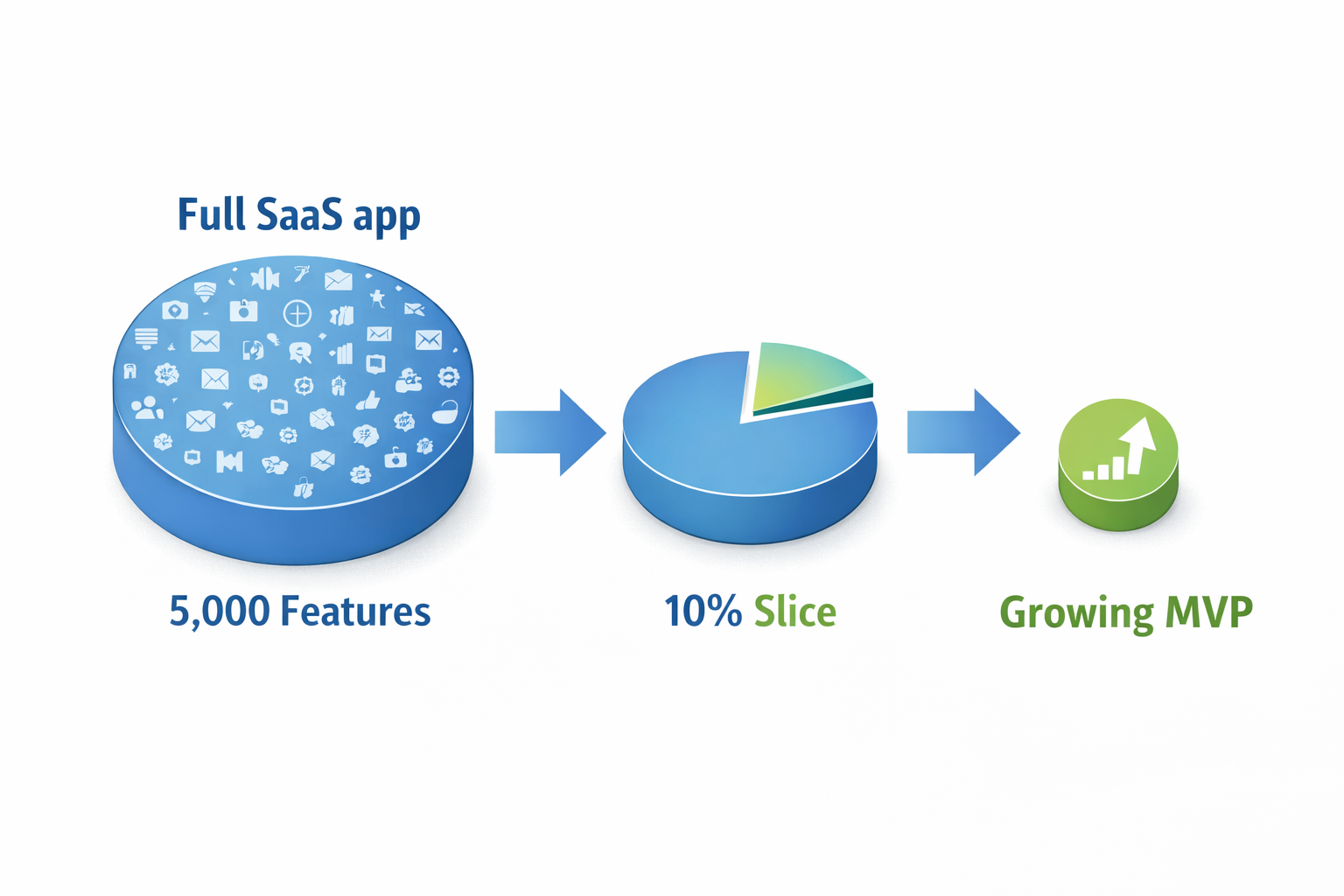
Large SaaS applications like Salesforce and Workday perform thousands of tasks to serve global enterprises across industries, company sizes, and regulatory regimes. The average enterprise Salesforce customer activates only 10-16% of available features—somewhere between 500 and 800 features out of more than 5,000. Enterprise software, it turns out, is a lot like hotel fitness centers: heavily marketed, rarely used, and somehow still factored into the price.
Joel Spolsky nailed this years ago: “80% of users use 20% of features—unfortunately, it’s never the same 20%.” This is precisely why vendors must build comprehensive feature sets even though any single customer only needs their slice.
Remember that old joke about the two men being chased by a bear, where one of them stops to put on his running shoes? He didn’t have to outrun the bear—he only had to outrun his friend. Companies don’t need to replicate an entire SaaS app. They only need to replicate the slice they actually use.
Picture it this way: full SaaS app → portion actually used → MVP needed to convert. That gap between the full app and the MVP is now crossable in ways it wasn’t before.
Vibe Coding vs. Agentic Engineering: A Critical Distinction
Before we go further, I need to address a common mistake I see constantly in commentary about this shift.
Critics often fall back on something like: “Nobody’s going to vibe code their CRM over a weekend.” They’re absolutely correct—and nobody said they would.
Vibe coding is opportunistic. It accepts whatever comes out. It’s casual, usually personal, and there’s no accountability. Steinberger considers the term a slur: “I do agentic engineering,” he told Lex Fridman. “And then maybe after 3 AM, I switch to vibe coding, and then I have regrets the next day.”
Vibe coding also describes what non-engineers do to put together personal apps—weekend projects that scratch a particular itch. Nothing wrong with that. But it’s not how companies will build enterprise software.
If vibe coding is paint-by-numbers, agentic engineering is a skilled professional accepting a commission and executing it with discipline and intention. Both uses involve brushes, paint, and canvas—but the products aren’t comparable. The professional produces work that serves a specific purpose for a specific client, with full understanding of what they’re creating and why.
The commercial argument runs like this: identify the 10% of your expensive per-seat CRM you actually use and build a purpose-built replacement. Not over a weekend. Not by someone half-asleep. By a disciplined practitioner who knows exactly what they’re building and why.
Pressure Points on SaaS Business Models
What we’re looking at are multiple reinforcing pressure points. Understanding them separately helps clarify where you’re vulnerable.
Pressure Point 1: Fewer People = Fewer Seats
AI replacing jobs means fewer employees who need software seats. This is the most obvious pressure point, though it comes with an important caveat: it only matters if the people being displaced are the ones using the SaaS app. A company laying off warehouse workers doesn’t reduce its Salesforce seats. But a company laying off sales reps does.
This applies primarily to per-seat models—but even non-per-seat vendors aren’t immune, as we’ll see.
Pressure Point 2: The Build vs. Buy Equation is Shifting
Software has always traded on value vs. cost-to-build. When Microsoft or Salesforce emerged, the cost to build equivalent functionality was prohibitive for all but the largest enterprises. So they bought!
Now one side of that equation—cost to build—is falling fast, recalibrating the entire evaluation. And the decision is no longer just “buy vs. build.” It’s “renew vs. replace or build.”
This is already happening across industries. For example, Valvoline, the automotive retailer with $1.7 billion in annual revenue, used an AI agent from the startup Torq to automate cybersecurity cleanup—locking down dormant accounts and monitoring suspicious logins—that would otherwise have required purchasing an additional tool from CrowdStrike. The company avoided spending roughly $115,000 and reduced the number of security employees on staff by at least two people. The CISO’s assessment: “It’s definitely reduced our reliance on CrowdStrike.”
Companies now have three viable paths that can make sense:
-
Build internally (starting with an MVP for their specific slice)
-
Buy from an AI-native challenger—a smaller, focused system whose specific capabilities match your needs precisely, free from the feature bloat (and resulting cost) of global mega-SaaS
-
Renew with incumbent—increasingly a defensive choice over the longer term, not a default
Pressure Point 3: AI-Native Disruptors Are Rising Faster Than Ever
Big company jobs are becoming less attractive, and talent is flowing toward entrepreneurship. The barrier to creating an AI-native competitor is shrinking dramatically.
There are some data supporting this trend, and it’s sustained. According to the U.S. Census Bureau Business Formation Statistics:
-
2023 saw the highest number of new businesses on record: 5.48 million
-
2024 remained elevated at 5.2 million new businesses—still 48% above 2019 levels
-
Through November 2025, over 5.1 million new businesses had formed
-
January 2026 business applications rose 7.2% month-over-month
This isn’t a one-year pandemic blip; it’s a sustained shift in entrepreneurial activity. Young entrepreneurs think AI is cool and want to see what they can do. Go figure!
Disruptors need an MVP larger than the “in-house developer slice,” but way smaller than the full SaaS app—and their products will be AI-native from the start, so they can grow more quickly.
Pressure Point 4: Data Ownership Is Becoming a Battleground
Many SaaS app managers are reluctant to share data with any apps that could replace what they do for customers. Some have banned data sharing outright, claiming customer data as their own. Personally, I agree more with the camp that says: “Every company is now an API company, whether they want to be or not.”
Yet the battle lines are being drawn. As The Information (paywall) reported, when a Wall Street analyst asked HubSpot CEO Yamini Rangan how the company planned to respond to clients using agents to pull data out of HubSpot and analyze it with AI from other providers, her answer was blunt: “We will monitor it, we will meter it, and we will monetize it. Our platform is…open by design, but we are not a free data pipeline for everybody to take that information out.”
You have to appreciate her candid style; it’s not often that a CEO announces the tollbooth while you’re still paying for the road!
That’s a hint at the kind of toll-gate tactics software executives may deploy—erecting barriers around customer data is a tactic we in the travel industry know well! Elsewhere, though, it’s a departure from the free data flow most SaaS companies have allowed in the past. Salesforce drew criticism last year after blocking third parties like Glean from storing Slack customer data. It will get worse before it gets better.
But there’s a huge risk that these tactics backfire. As one startup CEO put it: “If HubSpot or anyone else clamps down on data access, they are going to war with their own customers, especially their large customers, and it will be a disaster for them.”
Rolling your own apps avoids this entirely.
A warning to vendors hoarding data: you may buy time, but you’re poisoning the well. Companies will remember. All company data (the basic data the company generates in the normal course of business, not what you synthesize from it) will eventually revert to the company. The vendors who recognize this and lean into data portability will build trust; those who resist will find themselves on the wrong end of replacement decisions when the window opens. Angry customers don’t renew.
How Software Companies Are Responding
Despite the recent vintage of all this anxiety, the pressure is becoming visible. Workday, whose stock dropped 37% since the start of 2026, just replaced its CEO with co-founder Aneel Bhusri. Nothing says “situation normal” quite like summoning the founder from retirement! ServiceNow’s CEO and Atlassian’s CEO both canceled prearranged stock sales, showing they believe their stock will recover. Microsoft’s commercial chief sent memos to the sales team reminding them of the advantages over AI startups. (For me, this falls into the category of “if you have to ask…”)
Meanwhile, OpenAI told investors that future products and agents are expected to replace software from enterprise firms, including Salesforce, Workday, Adobe, and Atlassian. When OpenAI released Frontier, its management tool for business agents, and Anthropic unveiled new Claude Cowork features for legal document review and marketing campaigns, software stocks sold off immediately.
Some software executives are highlighting security risks—agents that can read emails can also be tricked by malicious instructions. That’s a real concern, though one that will be solved over time. Others, like Notion’s CEO, are taking the opposite approach: “If your product cannot be used by agents, I don’t think the future is very promising for you.”
The savvier incumbents are adapting rather than resisting. That’s not surprising. It’s literally always the right way. There’s just this inertia thing we have to contend with…
Where Will the Talent Come From?
You might be wondering: “Even if the economics work, where will companies find the talent to build all these MVPs and slices?”
The Great Reallocation
Our labor force has always been pretty low-friction, but it’s getting a serious shot of WD40 with these new GenAI capabilities. Employees inside companies who see the writing on the wall (layoffs coming, reduced teams) have an incentive to develop agentic engineering skills now rather than be caught without marketable capabilities when the axe falls. This includes travel companies as well.
These employees become the talent pool for either internal build initiatives or for joining and founding AI-native startups. Workers displaced from larger organizations might also look to re-enter the workforce at smaller companies or start their own. Young people disillusioned with big-company work, whether fresh from school or never having gone, are streaming into entrepreneurship.
The Entrepreneurship Surge
According to the Global Entrepreneurship Monitor, nearly one-fourth of 18-24 year-olds are currently entrepreneurs, and 21% intend to start a business within three years—the highest rates of any age group in 25 years of tracking. This isn’t talent flowing to existing startups—it’s talent creating new companies.
The entrepreneurial infrastructure was already primed before GenAI. The AI acceleration since late 2023 is building on an already elevated baseline. Picture it as a flow: talent leaving large companies → founding startups; talent leaving traditional employment → entrepreneurship. The current is strong and getting stronger. If you’re in a large company with some serious engineering talent, now’s the time to let them know you want them to stay.
Implications for Travel Technology Companies
So the bottom line is that travel technology has no inherent immunity to these forces.
The SaaSpocalypse assaults per-seat pricing. Agentic engineering mugs the entire business model. The same forces operating on CRM, HRIS, and productivity software apply to travel applications.
In fact, travel’s existing exposure to structural change may actually increase vulnerability. The industry has weathered successive waves of disintermediation from OTAs, metasearch, and mobile-first booking, and absorbed genuine Christensen-style disruption from the likes of Airbnb and Kiwi.com, both of which entered through segments the big incumbents ignored and eventually integrated into mainstream distribution. Companies that survived learned to compete, but accumulated technical debt and organizational complexity along the way. Agentic engineering doesn’t replace these pressures—it intensifies them while adding new ones. Gird your loins for this next round.
The Full Business Model Is Under Pressure
App functionality is one component of the value proposition. The value proposition is one component of the business model (the right side of the Business Model Canvas). The entire right side of the BMC—customer relationships, channels, support, the complete delivery mechanism—is under pressure, not just the sticker price. Come to think of it, the left side of the canvas is under assault as well.
When you think about which travel tech companies are vulnerable, here are a few things to consider:
Characteristics of some particularly vulnerable vendors:
-
Legacy applications in old, brittle codebases (you knew the day was coming)
-
Modern applications that expanded in many directions to serve many masters (feature bloat – are you a 10-16% kinda app?)
-
Single-customer companies with concentrated risk (living on borrowed time)
-
Data hoarding as a moat strategy (a short-term solution, with consequences, to a long-term problem)
-
Commodity functionality without differentiation (the eternal price war)
Per-seat pricing in travel tech is less pervasive than in CRM, payroll, or HR software. But where it exists, the pressure applies. And it’s not the biggest source of pressure.
But There Are Opportunities, Too
For travel tech companies in the distribution ecosystem, preparing for agentic commerce illustrates a new and important capability. I’ve written about this elsewhere, but the implications are significant enough to recap here.
In web commerce, suppliers and aggregators try to capture attention to drive transactions. But agents have no attention to capture; what they do have is memory. A consumer’s agent (like ChatGPT) builds intent from internal memory (previous conversations, stated preferences) and external memory (emails, calendars, reviews, travel profiles). By the time the agent goes shopping, it hasn’t watched any ads, there’s no sponsored content, and it doesn’t care how many people have a hotel in their shopping cart. It’s immune to the persuasion signals that dominate web distribution.
For travel tech, the supplier side is where the action is. Hotels and airlines will deploy their own agents (or MCP servers) to interact with consumer agents programmatically. The seller agent’s job is to get into the buyer agent’s consideration set and, ultimately, its memory. This isn’t about bidding for placement or optimizing click-through rates; it’s about surfacing a personalized offer to the right agent at the right moment to get the booking, then delivering an experience worth remembering. Travel technology vendors sit squarely in the middle of this exchange. They build the systems that determine what a supplier’s agent can offer, how fast it can respond, and whether the resulting stay creates artifacts that feed back into the buyer agent’s memory.
This creates a marketing-memory flywheel. Personalization drives a better stay; the better stay generates positive artifacts (reviews, social posts, email exchanges); those artifacts feed back into agent memory and make the next recommendation more likely—without buying demand back through an intermediary.
Startups and challengers will support agentic commerce from day one. Incumbents may be slow to respond. The window for incumbents to adapt is open now, but it won’t stay open forever.
What Should Companies Using Travel Technology Do?
If you’re a company using travel technology, here’s how to approach the new landscape.
Rethink the Buy vs. Build vs. Renew Decision
Cost is a primary factor. It doesn’t make sense to spend time replacing applications that are cheap to run. Evaluate the expensive ones first. See which apps have functionality you barely touch. Identify candidates for internal MVP development. Renewal is no longer the default—it’s a choice against some newly-viable alternatives.
Identify What NOT to Replace (At Least Not First)
Some systems carry enough friction that you’ll want to throw them in the “too hard” pile for now. Others may be good candidates once you get going, but not for your first attempt. Here is a decidedly non-exhaustive list of friction sources:
Audit and compliance exposure. General ledger and other systems subject to external audit have controls, formats, and sign-off requirements that make them risky early candidates. Getting it wrong could be a career-ender.
External coordination. Systems that must speak specific protocols to outside parties (GDS connections, payment networks, government reporting) require you to build to, and then be accepted by, those parties. You don’t control the timeline.
Mission-critical availability. Systems where transition risk is existential (central reservation during peak season, for instance) need battle-tested replacements, not experiments. These systems might be among the most lucrative to replace so definitely keep them in the consideration set. Just be extra careful about what you might not know. Consider whether you might be able to replace them in pieces rather than all at once.
Deep internal integration. Applications that reach into many other systems create cascading dependencies. Replacing them means coordinating changes across multiple teams and codebases simultaneously.
Contractual constraints. Long-term contracts, termination penalties, and proprietary data formats create exit friction that has nothing to do with technical feasibility.
The best early candidates are systems that are neatly circumscribed: internal users, limited integration points, and no external parties who need to bless the change. Systems of record deserve extra scrutiny; data migration, audit trails, and integration dependencies tend to compound. This doesn’t mean “don’t replace,” it means “understand what you’re signing up for.”
Account for Institutional Knowledge Embedded in the Vendor
Here’s a hidden problem that will bite many companies: over time, your vendor has likely made many customizations to accommodate strange subtleties in how your company operates. I once worked with a company whose primary customer history file had a date field that changed its definition based on the contents of another field. It was a landmine we luckily tripped over. You’ll need to either fix (or replicate) these customizations or re-engineer the workflows that previously depended on them.
The harder problem is knowing these customizations exist in the first place. Much of your operational logic may have been absorbed and internalized by a third-party vendor who’s been with you for years.
We can’t underestimate how much of our operations live inside vendor systems in ways we’ve forgotten about.
Retain Engineering Talent for Strategic Build
If you create MVPs quickly and extend into your “slices”, you can keep your best engineering staff. Avoid layoffs while targeting the next expensive app on your list. Expect to extend functionality over time—it’s not “complete replacement,” it’s “MVP plus iteration.”
Protect Your Data Rights
If signing a new SaaS vendor, ensure your data is your data. Push for unfettered access for any other purpose. Resist terms that let vendors claim ownership of your data: it’s the lifeblood of your business.
What Should Travel Technology Vendors Do?
If you’re a travel technology vendor, start by getting your head around the potential for positives: these forces can propel you, not just threaten you. Recognize these dynamics early and use them to build a more defensible strategy. The same capabilities that enable challengers are available to you. This is about adapting to change, not rolling over.
Examine Your Business Model for Opportunities
Start by mapping where value currently flows. Where do you capture margin? Where do your customers capture margin? What’s the fundamental value you bring to customers in terms of the things they need to do rather than just in the way you currently happen to do them? Which parts of that flow are stable, and which are vulnerable to the dynamics we’ve described?
Look for opportunities hiding inside threats. If per-seat pricing is under pressure, what consumption-based or outcome-based models might work better for your customers and for you? If customers can build simple functionality themselves, can you move upmarket toward harder problems? If integration is getting easier, can you become the hub rather than a spoke?
Ask where the irritations live. The 10% problem means your customers aren’t using most of what they pay for. That’s a vulnerability, but it’s also an opening. What if you could deliver the 10% they actually use at a lower price point with higher satisfaction? What would you need to shed to make that work?
Consider what “single throat to choke” means in your market. For some customers, having one accountable vendor simplifies operations and reduces risk. That’s a sustaining advantage, but only where it applies. Where does complexity favor consolidation? Where does modularity favor best-of-breed? Your answer may vary by customer segment.
Re-Examine Your Strategic Position
Dust off your copy of Helmer’s 7 Powers and assess your company’s durable differences honestly. (And reread the book—there’s a lot of nuance there!) Which powers do you currently have? Which could you build? A few things to consider:
Process power. Do you have embedded organizational capabilities that would be difficult to replicate? Proprietary workflows, operational expertise, or institutional knowledge that compounds over time?
Cornered resource. Do you control something scarce: unique data (actually yours, not customer base data), exclusive supplier relationships, talent that competitors can’t easily poach?
Switching costs. How deep are your integration points? Are customers locked in by technical dependencies, by workflow habits, or by contractual terms? Which of these will hold up as integration gets easier?
Network effects. Does your product become more valuable as more customers or partners use it? If not, could it?
Scale economies. Do you have cost advantages that scale with volume? Or are you subscale in ways that will become more painful as larger competitors invest in AI capabilities?
Counter-positioning. Is there a move you could make that incumbents (or larger competitors) would find difficult to copy because it would cannibalize their existing business? Can you disrupt them…or yourself?
Brand. Do customers pay a premium simply because of who you are and your reputation?
Be specific. “We have switching costs” is not a strategy. “Our PMS integration touches 14 other systems and would take X months to replace” is a fact you can build on.
Think About the AI-Native Move
How does AI-native architecture apply to your products and customers? How much do you need to adapt, and by when? Document each step of your transition plan. The companies that move earliest have the most options.
Here’s a thought experiment. Suppose your company no longer existed and you decided you wanted to get back into the business to serve the same kind of customers you previously served, but without any constraints of legacy teams, processes, or code. What would you do differently? If you were starting from scratch with whatever’s in your head, some funding, and a few key staff, how would you build from the ground up?
Now realize that there are probably lots of startups doing just that right now, looking for ways to enter your business and take your customers. If you know what you would ideally like to be, what can you do to get there? How can you change your business to better meet the startup challengers and win? Rethink your business, rebuild your strategy, and use AI to get you there faster.
How Others Have Done It: Transformation Examples
It’s worth examining how other companies (outside travel) have navigated similar existential threats. These aren’t perfect analogies, but the patterns are instructive and everyone knows the organizations.
Adobe: From Perpetual Licenses to Subscription Platform
The threat: By 2012, Adobe faced declining upgrade rates, software piracy exceeding 40% in some markets, and unpredictable revenue tied to major releases every 18-24 months. Creative Suite sold for ~$2,600, but customers only upgraded every 3-4 years.
The business model change: Adobe eliminated perpetual licenses entirely by 2015, shifted to Creative Cloud subscriptions ($50/month), and moved from product vendor to platform provider—bundling tools with cloud storage, fonts, and collaboration features that didn’t exist under the old model.
New sources of power: Adobe used the transition to build switching costs that didn’t exist before—once users invest in learning the ecosystem and storing work in Creative Cloud, switching becomes more difficult. They also created network effects through Behance integration and shared libraries, and developed process power through continuous deployment that perpetual-release competitors couldn’t match.
The irony is not lost on me that this is a SaaS application subject to the SaaSpocalypse, but hey, if they pivoted once, they can do it again. The first time is often the hardest.
Microsoft: From Windows-Centric to Cloud Platform
The threat: By 2014, Microsoft had missed mobile entirely, was late to cloud (behind AWS), and was losing relevance as computing shifted away from the PC. The company culture was notoriously siloed and combative.
The business model change: Under Satya Nadella, Microsoft shifted from Windows-centric to “cloud-first, mobile-first.” They made Office available on iOS and Android (which never would have happened under Ballmer), embraced open source, including Linux on Azure, moved from selling software licenses to subscription services, and acquired strategic ecosystem assets: LinkedIn ($26.2B), GitHub ($7.5B), Nuance ($19.7B).
New sources of power: Microsoft dramatically strengthened network effects through LinkedIn and GitHub. They enhanced switching costs by creating an integrated stack (Azure + Office 365 + Dynamics 365 + Teams) that’s painful to replace piecemeal. And they acquired cornered resources—GitHub (the world’s largest developer platform), LinkedIn (professional data), and the OpenAI partnership.
Netflix: From DVD Mail to Streaming Originals
The threat: By the mid-2000s, Netflix’s DVD-by-mail business had some operational advantages, but these wouldn’t transfer to streaming. All content was licensed, meaning costs rose with revenues, and there was no path to sustainable advantage.
The business model change: Netflix pivoted from DVD rental to streaming platform, then made the critical shift from licensing content to producing original content. This turned content from a variable cost (paying per view) to a fixed cost (paying once, amortizing across millions of subscribers).
New sources of power: By creating original content, Netflix developed scale economies that didn’t exist when all content was licensed—the more subscribers, the lower the per-subscriber content cost. They built a cornered resource through exclusive series and films. And they established counter-positioning first against Blockbuster, then against linear TV—a streaming model that traditional media companies couldn’t adopt without cannibalizing their existing businesses.
Common Patterns Across These Transformations
They attacked their own business models before competitors could. Adobe killed perpetual licenses. Microsoft made Office available on competitor platforms. Netflix shifted resources to streaming before DVD revenue peaked. Waiting for the market to force change meant waiting too long. It’s the corporate equivalent of remodeling your lobby because you want to, not because the health inspector is standing in it.
They changed what creates switching costs. All three built new switching costs that didn’t exist under their old models—typically through platform integration, data accumulation, and ecosystem lock-in. The old switching costs (familiarity with installed software, physical DVD collections) were eroding anyway.
They moved from product to platform thinking. Adobe became Creative Cloud. Microsoft became the Azure/365/Dynamics stack. Netflix became a content platform. Single products are easier to replace than integrated platforms.
The transformation took years, not months. Adobe’s transition ran from 2011 to 2017. Microsoft’s began in 2014 and is ongoing. Netflix’s streaming pivot began around 2007, and the original content push started in 2013. This isn’t something you execute in a quarter. That said, the accelerating pace of technology today is reducing timeframes. Expect the runway to go from years to quarters.
Process power emerged as a sustaining advantage. Companies that can iterate faster, deploy AI more effectively, and make data-driven decisions at scale develop advantages that are hard to replicate because they’re embedded in organizational capability, not just technology. Your advantages have to keep compounding: this is not ‘set it and forget it.’
For travel tech vendors facing the SaaSpocalypse, the lesson is that the companies that survived existential disruption moved before they were forced to, attacked their own business models, and used the transition to build new sources of power that didn’t exist under the old model. All three companies moved when the threat was visible but not yet fatal, and they emerged stronger.
Conclusion: The Call Is For Adaptation, Not Doom
This isn’t a doomsday piece. It’s a call to recognize what’s happening and understand your risks.
For companies using third-party software, it means understanding what your new options are. Agentic engineering can seriously reduce the time, money, and feasibility of replacing bloated software designed to power many masters with something streamlined and customized to your specific needs. And keep your data. And keep your key software engineering resources. Oh, and maybe save a lot of money.
For vendors, the risk is in failing to understand what’s happening and act accordingly. This change won’t show up in your P&L today—but your customers’ decision to embark on a new direction could start forming today. Don’t wait until it’s set in stone, because it’ll definitely show up in your P&L then. Whenever we think we have a fix on how fast AI is moving, it surprises us by accelerating even faster. That’s unlikely to change.
No software company, SaaS or not, is unassailable. All the dynamics that made disruption work before still apply: inertia, reluctance to change business models, the innovator’s dilemma. The difference is that it’s coming faster. Thomas Cook operated for 178 years before collapsing in 2019; the next Thomas Cook won’t get that kind of runway. Even the largest incumbents can be brought down by disruption. This applies to everyone, from the biggest to the smallest vendor.
Recognizing this early and acting on it is a competitive advantage.