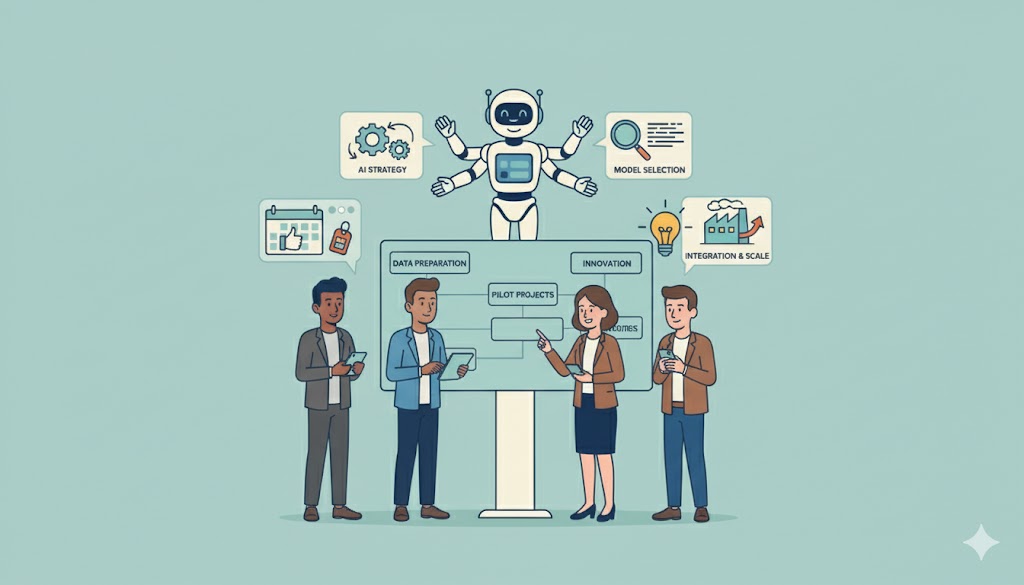
Imagine transforming your travel company from the ground up with GenAI at its core. What if your organization were designed today with AI baked into its DNA?
By now, most companies are at least experimenting with GenAI in some form or another, testing its capabilities and, in some cases, building proofs of concept and even applications. As with any new technology, some companies are dabblers while others are actively planning their long game which, given how fast GenAI is advancing, could be just the next 2-3 years!
In researching the explosion of GenAI over the past 2 1/2 years, I’ve come to believe that the ones in the latter category are building capabilities that will allow them to move much further and much faster over time. I’ve also seen how the more proficient companies have brought GenAI into the organization and how they grow it, and it’s neither a scattershot effort nor an all-at-once effort. They’re building a GenAI foundation that:
- includes broad based indoctrination of GenAI across the organization,
- is expressed with a common core of models and capabilities, and
- creates a flexible extension of the technology into their processes and products.
There are plenty of examples in the press; today’s is from JP Morgan Chase.
In this post, I’ll describe what I believe are the four levels of GAI adoption and elaborate on the first one in more detail. I’ll cover the remaining three levels in subsequent posts along with some short segues into related topics. Having worked with a variety of companies in my 16 years of consulting, I’ve come to understand how many companies think and I understand that in most cases, it’s not easy to adopt new technology: especially something as pervasive, powerful and potentially threatening as generated AI. I do, however, believe in the enormous potential for GAI to elevate both personal and company performance, so planning for its adoption is hugely worthwhile.
Some companies have successfully integrated GenAI throughout their organization, though today that’s mostly limited to new entrants who built their organizations around the technology. Companies that are not GenAI-native need a plan for adopting the technology into their core.
“How would we design our company today, knowing what we know about our customers and their current and future needs, and design GAI into the core of the organization from the start?”
Let’s get started by briefly describing the levels of adoption.
The 4 levels of GenAI adoption
Level 1: Individual Productivity
Use GAI to amplify the productivity of individuals within their own jobs. Examples include using a company-level LLM license to help each employee perform the tasks for their jobs better and faster. We’ll expand on level 1 in the next section.
Level 2: Business Function Capabilities
Use GAI to create new capabilities at the business function level. In this context, business functions include things like product management, marketing, finance, legal, customer service, technology, etc.
GAI adoption at this level can streamline processes, automate tasks, and improve data accuracy. This can lead to significant time and cost savings, freeing up employees to focus on higher-value activities. Examples include use cases like customer service chatbots and cross-functional coding companions in engineering. Note this is different from the co-pilots in level 1. Here, the emphasis is on workloads that reach across multiple people and business functions.
From a customer perspective, GenAI can personalize customer experiences, provide faster and more accurate service, and improve communication. This can lead to increased customer satisfaction and loyalty.
Level 3: Product and Service Innovation
Use GAI to create new products and services, altering existing product business models or creating new ones. GAI can enable new product value propositions, open up new customer segments, etc. One frequently used path at level 3 is with premium products and services where GenAI can lower the cost to serve enough to enable the company to extend its services to lower priced segments. The trick here is to leave enough differentiation with the original service to keep them distinctly valuable to their respective segments.
For example, consider luxury travel agencies with premium personal service. The cost to serve here is very high because of all the personal touches. Yet if GenAI can be deployed to reduce the cost to serve (like automating significant portions of itinerary preparation, research, itinerary monitoring to anticipate and mitigate travel interruptions, etc.) an agency could not only save money on its current service but also provide a somewhat less personalized version of it to a new class of customers who can’t afford the highest tier of service but who will respond to the brand and pay something for a slightly lower tier.
GAI can enable the development of new products and services that would not be possible without its capabilities. This can open up new markets and revenue streams.
Level 4: Business Model Transformation
Use GAI to change or create new business models at the company level based on new capabilities it can provide. This level allows the company to ask the question: “How would we design our company today, knowing what we know about our customers and their current and future needs, and design GAI into the core of the organization from the start?”
GAI can facilitate the creation of entirely new business models, disrupting existing industries and creating new opportunities for growth and innovation.
Make no mistake, if you bring GenAI into your company as an add-on to your existing processes and products, you may greatly enhance your current capabilities but you will still not be competitive with GAI-native companies. For that, you have to conceptualize what your company might look like if it were built from the ground up today with AI capabilities at the core… and then plan how to move your company to that state. In that sense, the careful adoption of GenAI is a competitive precursor to becoming AI native.
Now let’s drill down on level 1.
Level 1: Establishing the AI Mindset — the first level of GenAI adoption that empowers individual contributors
(Note: We’re using the term AI Mindset as initially described by Conor Grennan)
The first step in an organization’s GenAI adoption journey begins at the individual level, establishing a foundation of GenAI understanding and capability that precedes more complex integration into company processes and products. This preparatory phase is critical for reducing resistance and building confidence and practical skills in working with GenAI. Think of it like learning to ride a bicycle before trying to ride a motorcycle: the fundamentals of balance and familiarity with simple maneuvers like turning and braking lay a necessary foundation before you can deal with the added complexity of biking with a motor.
Overcoming Barriers to Adoption
Despite the broad accessibility of GenAI tools (there are literally new ones coming out every week that can be easily accessed with a web browser) many employees are hesitant due to the traditional three horsemen of change: fear, uncertainty, and doubt. To be successful, organizations must address these barriers through practical demonstrations rather than abstract explanations. Seeing really is believing. Showing employees how to use these tools in real-life scenarios relevant to their work is far more effective than just talking it up. When the company provides access to a capable model like GPT-4o or Claude or Gemini and provides hands on training in how to use them, most employees will begin to dabble with a variety of requests and use this free form experimentation to ‘get the hang’ of using GenAI. As they gain confidence with it, they can progress to more complex queries with larger business tasks like helping with data analysis or document preparation. Learning to effectively use GenAI isn’t a ‘one and done’ effort—it requires ongoing training and expansion of potential use cases for individuals. And because the GenAI arena is so dynamic, smart companies will keep staff informed of new capabilities their models can provide so they can expand their own repertoires.
Creating a Culture of Experimentation
Organizations that excel in early GenAI adoption encourage experimentation and iteration and keep doing so. This helps employees develop innovative thinking patterns and avoid the tendency to fear whether they’ll be able to use it effectively, if at all. Leadership plays a crucial role in creating a culture where employees feel safe to explore, make mistakes, and learn from their GenAI interactions. For example, because today’s models continue to hallucinate (though less than in prior years) encouraging staff to use good hygiene by requesting citations and checking results remains a necessary part of everyday use. There’s no substitute for ‘getting the feel’ of the models and seeing which yield the best answers for different types of questions.
Human-AI Collaboration
Many employees are concerned about reports of the potential for GenAI to take a variety of jobs in the future. While this may be true (and we’ll address this directly in the next post) the most successful approach frames AI not as a replacement but as an enhancement to human capabilities. This collaborative approach empowers knowledge workers by reducing cognitive load on repetitive or analytical tasks, allowing them to focus on strategic thinking and creativity. GenAI today can take over many of the lower level tasks in knowledge workers’ jobs and allow them to create on more interesting things. It also helps workers expand their thinking about how to be more expansive and productive as they find new ways of using the technology.
Examples in the Travel Industry
- Travel Agents who are earlier in their career can use GenAI to quickly generate personalized itineraries based on customer preferences, then refine these with personal research, learning as they go along. More experienced agents can use GenAI to find interesting, out of the way options that might otherwise require extensive personal research and use them to create the highly personalized itineraries their customers are willing to pay for.
- Hotel Concierges can employ AI to research and summarize local attractions and dining options in seconds, allowing them to provide more thoughtful recommendations with personal touches. It also allows them to stay up to date on new events and find unique combinations of services for each traveler’s needs.
- Revenue Managers can utilize GenAI to analyze pricing trends and competitor data, then apply their strategic judgment to make optimal pricing decisions. While many RMS already include AI features in their predictions, GenAI can help DORMs to keep up to date on events and conditions that may impact demand that haven’t yet gone into the RMS’ assumptions.
- Marketing Teams can generate multiple content variations for destination descriptions, then enhance these with brand voice and emotional appeals that resonate with target travelers. Property descriptive data can be customized to different categories of travelers in ways that might not be conventional, but that might be very effective.
Conclusion
This first, foundational level of AI adoption serves as a catalyst for further innovation, as employees who become comfortable with these tools naturally begin to envision applications at higher organizational levels. Like the bicycle rider who becomes an accomplished cyclist before adding in the motorcycle’s complexity of a throttle, clutch, and headlights, the confidence and knowledge of individual use leads naturally to the ability to envision new uses for GenAI in company processes and products. By focusing on this initial phase of individual empowerment, organizations create the conditions necessary for more sophisticated AI integration in the future and can show staff how GenAI can be a companion rather than a threat.
So, what steps can you take today to build a GenAI-ready culture in your company?